Bussed and bused are both correct spellings, but they are used in different types of English. Many writers pause when they need the past tense of the verb bus.
Should it be bused or bussed? Both forms appear online, in books, and even in professional writing, which makes the confusion very common.
This doubt exists because English spelling rules are not always consistent. Some verbs double the final consonant before adding -ed, while others do not.
For example, stop becomes stopped, but open becomes opened. The verb bus falls between these rules, so writers are unsure which form is right.
Regional spelling also adds to the confusion. American English and British English often follow different patterns, and many writers want to choose the correct form for their audience.
This article explains the correct usage, spelling rules, regional differences, and common mistakes, so you can use bused or bussed with confidenc
Bused or Bussed – Quick Answer
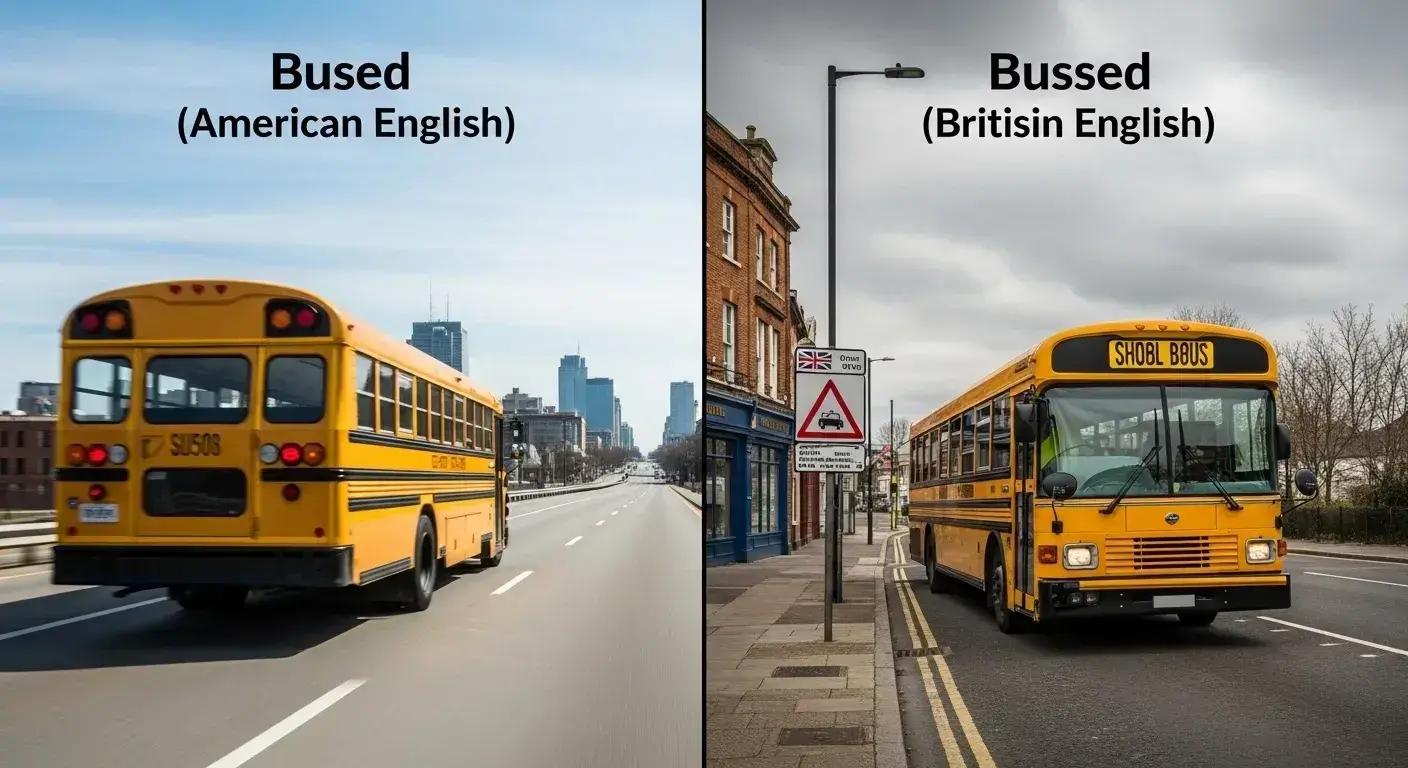
Both spellings are correct, but usage depends on region.
- Bused → Preferred in American English
- Bussed → Preferred in British English
Examples:
The students were bused to school. (US)
The fans were bussed to the stadium. (UK)
The Origin of Bused or Bussed
The verb bus comes from omnibus, a Latin word meaning “for all.” In the 1800s, omnibus was shortened to bus and became common in English.
When English forms past tense verbs, spelling rules apply:
- If a verb ends in a single vowel + consonant and the stress is on the last syllable, the consonant doubles (stop → stopped).
- If the stress is not on the last syllable, it usually does not double (visit → visited).
The word bus is short and unusual. Over time, American English chose bused, while British English favored bussed. Both forms became accepted, leading to today’s confusion.
British English vs American English Spelling
This is a clear case of regional spelling preference.
| Spelling | American English | British English |
| bused | Correct | Less common |
| bussed | Less common | Correct |
American English tends to avoid doubling letters when possible. British English follows the doubling rule more often.
Which Spelling Should You Use?
Choose the spelling based on your audience.
Use “bused” if you are writing for:
- United States readers
- American schools or universities
- US-based websites or blogs
Use “bussed” if you are writing for:
- UK readers
- British or Commonwealth audiences
- UK media or academic work
For global audiences:
Both are correct, but bused is more widely understood.
Common Mistakes with Bused or Bussed
❌ Mixing spellings in the same text
✅ Stay consistent
❌ Assuming one spelling is wrong
✅ Both are correct
❌ Using the noun spelling instead of the verb
✅ Bus (noun) vs bused/bussed (verb)
❌ Letting spellcheck choose randomly
✅ Match spelling to audience
Bused or Bussed in Everyday Examples
Emails:
The employees were bused to the office.
News:
Protesters were bussed into the city.
Social media:
We got bussed to the concert tonight!
Formal writing:
Students were bused safely to the event.
Casual speech:
They bussed us downtown.
Bused or Bussed – Google Trends & Usage Data
Search data shows:
- High searches from students and ESL learners
- Frequent confusion in academic writing
- Regional spikes based on country
By region:
- United States: “bused” dominates
- United Kingdom: “bussed” dominates
- Global searches: both appear, with slight preference for “bused”
Context matters:
- News and formal writing follow regional rules
- Informal writing may use either spelling
Bused vs Bussed: Comparison Table
| Feature | Bused | Bussed |
| Correct spelling | Yes | Yes |
| American English | Preferred | Acceptable |
| British English | Acceptable | Preferred |
| Dictionary accepted | Yes | Yes |
| Global usage | Common | Common |
FAQs About Bused or Bussed
1. Is bused correct English?
Yes. It is standard in American English.
2. Is bussed correct English?
Yes. It is standard in British English.
3. Which spelling is more common?
Bused is more common worldwide.
4. Can I use both in the same article?
No. Choose one and stay consistent.
5. Do dictionaries accept both spellings?
Yes, major dictionaries list both.
6. Is one spelling more formal?
No. Both are equally formal.
7. Which should ESL learners use?
Use bused for simplicity unless writing for the UK.
Conclusion
The confusion between bused or bussed comes from regional spelling differences, not from correctness. Both spellings are right, and both are accepted in standard English. The key is knowing when to use each one.
If you are writing for an American audience, bused is the best choice. If your readers are in the UK or Commonwealth countries, bussed fits better. For global audiences, bused is slightly safer because it is more widely used.
The most important rule is consistency. Pick one spelling and use it throughout your writing. This keeps your work clear, professional, and easy to read.
Understanding small spelling differences like this improves your writing and helps you communicate with confidence.
Learn more:
Gnarly or Narly: Which Word Is Correct ?(2026)

Evan L. Morwick is an English grammar writer and usage analyst.
He works in orthography, lexicography, and grammatography, focusing on common errors.
His articles explain spelling, word choice, and sentence clarity.
Evan helps learners write accurate, modern English.