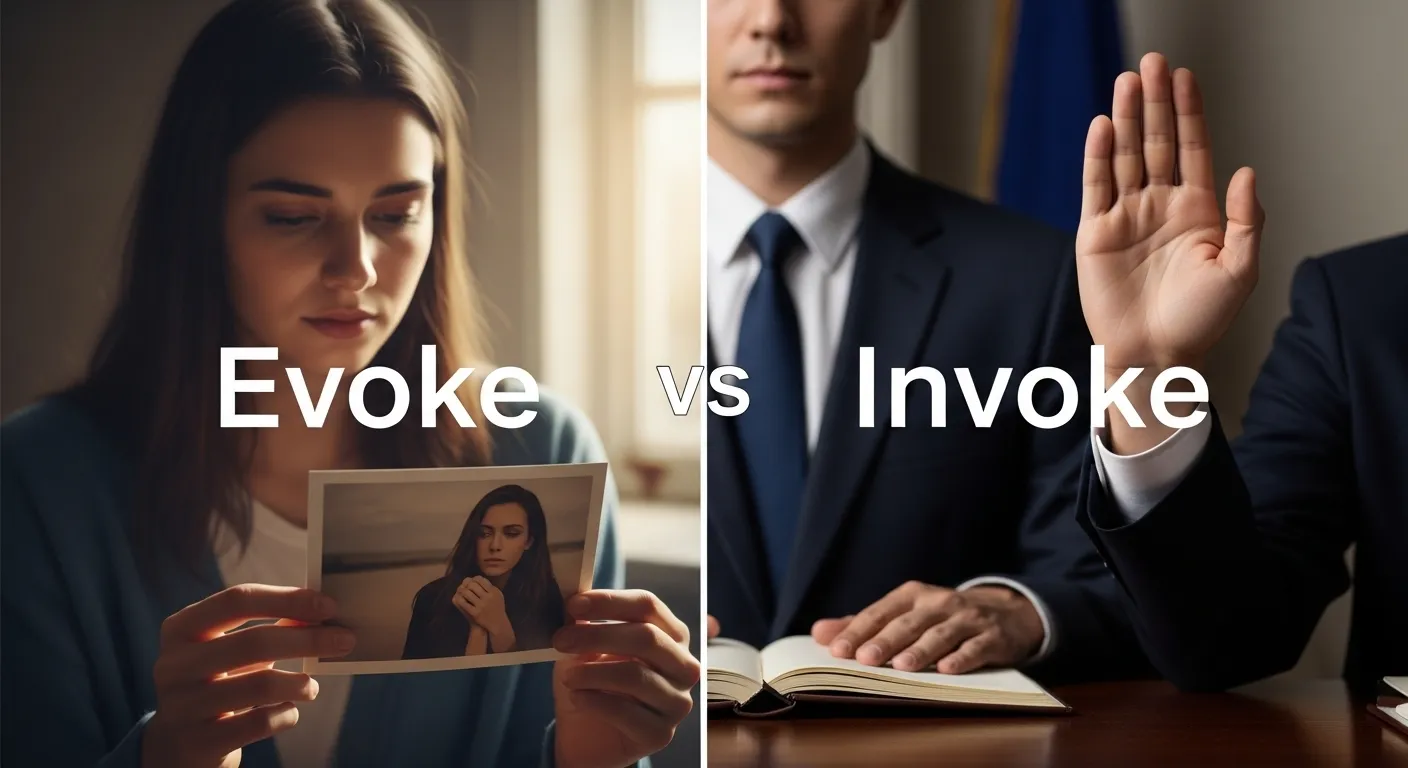
Evoke means to bring a feeling, memory, or image to mind.
Invoke means to call on something for support, authority, or action.
Many English learners and even native speakers feel confused when choosing between evoke and invoke. Both words sound formal.
Both are used in writing, speeches, and news articles. Because they appear in similar situations, people often mix them up. That is why many users search for evoke or invoke online.
The confusion usually happens because both words deal with ideas, feelings, or actions that are not physical.
Writers may wonder: should I evoke a feeling or invoke a feeling? Can I invoke a memory? Is evoke more emotional and invoke more legal? These questions are common.
Using the wrong word can change the meaning of a sentence. In professional writing, academic work, or formal emails, this can cause misunderstanding. Clear word choice matters.
Evoke or Invoke – Quick Answer
Evoke means to bring a feeling, memory, or image to mind.
Invoke means to call on something for support, authority, or action.
Examples:
The song evoked happy memories.
The lawyer invoked the law.
Easy tip:
Feelings = evoke
Rules, power, or authority = invoke
The Origin of Evoke or Invoke
Both words come from Latin, which explains why they look similar.
Evoke comes from the Latin evocare, meaning “to call out” or “to draw forth.” Over time, it came to mean calling out emotions, memories, or images in the mind.
Invoke comes from the Latin invocare, meaning “to call upon.” It kept a stronger sense of action, power, or authority. It is often linked with laws, rights, traditions, or even prayers.
The spelling difference exists because the meanings developed differently, even though both words share the idea of “calling.”
British English vs American English Spelling
There is no spelling difference between British and American English for these words.
| Word | British English | American English |
| evoke | Correct | Correct |
| invoke | Correct | Correct |
The difference is about meaning, not spelling or region.
Which Spelling Should You Use?
You should choose based on meaning, not audience location.
Use evoke when:
- Talking about emotions
- Describing memories
- Creating imagery
- Writing creatively
Use invoke when:
- Referring to laws or rules
- Calling on authority
- Making formal requests
- Talking about rights or powers
Audience advice:
- US audience: same rules apply
- UK/Commonwealth audience: same rules apply
- Global audience: same rules apply
Meaning matters more than location.
Common Mistakes with Evoke or Invoke
❌ The speech invoked strong emotions.
✅ The speech evoked strong emotions.
❌ She evoked the law to defend herself.
✅ She invoked the law to defend herself.
❌ Using invoke for feelings
✅ Use evoke for feelings
❌ Using evoke for rules
✅ Use invoke for authority
Evoke or Invoke in Everyday Examples
Emails:
Your message evoked a sense of trust.
News:
The court invoked emergency powers.
Social media:
This photo evokes nostalgia.
Formal writing:
The policy invokes constitutional rights.
Speeches:
The leader evoked hope among citizens.
Evoke or Invoke – Google Trends & Usage Data
Search data shows:
- Both words are searched often by students and writers
- Evoke appears more in creative and emotional contexts
- Invoke appears more in legal, political, and academic content
By country:
- High search interest in the US, UK, India, and Australia
Search intent:
- Understanding meaning differences
- Correct usage in writing
- Avoiding grammar mistakes
This shows strong demand for clear explanations.
Evoke vs Invoke: Comparison Table
| Feature | Evoke | Invoke |
| Main meaning | Bring feelings or memories | Call on authority or power |
| Emotional use | Yes | No |
| Legal or formal use | Rare | Common |
| Creative writing | Common | Rare |
| Academic or legal writing | Rare | Common |
FAQs About Evoke or Invoke
1. Can evoke and invoke be used together?
Yes, but only if meanings fit.
2. Is evoke always emotional?
Mostly, but it can also refer to images or ideas.
3. Is invoke only legal?
No, but it often involves authority or action.
4. Can you invoke a memory?
Not usually. You evoke a memory.
5. Which word sounds more formal?
Invoke sounds more formal.
6. Are they interchangeable?
No, their meanings are different.
7. Which one should I use in creative writing?
Evoke is usually better.
Conclusion
The difference between evoke or invoke is small but very important. Both words involve “calling,” but they call different things. Evoke brings emotions, memories, or images into the mind. Invoke calls on authority, power, rules, or formal action.
Remember this simple rule:
If you feel it, evoke it.
If you call on it for power, invoke it.
Using the correct word improves clarity and professionalism. Whether you are writing an email, article, speech, or academic paper, choosing the right term shows strong language skills. With practice, the difference becomes easy and natural.
Learn about:
Fetuses or Feti: Which Plural Is Correct ?

Lena Whitcroft is an English grammar specialist and language writer.
She focuses on spelling differences and sentence correctness.
Her articles are designed for global English learners.
Lena believes clear grammar leads to clear communication.