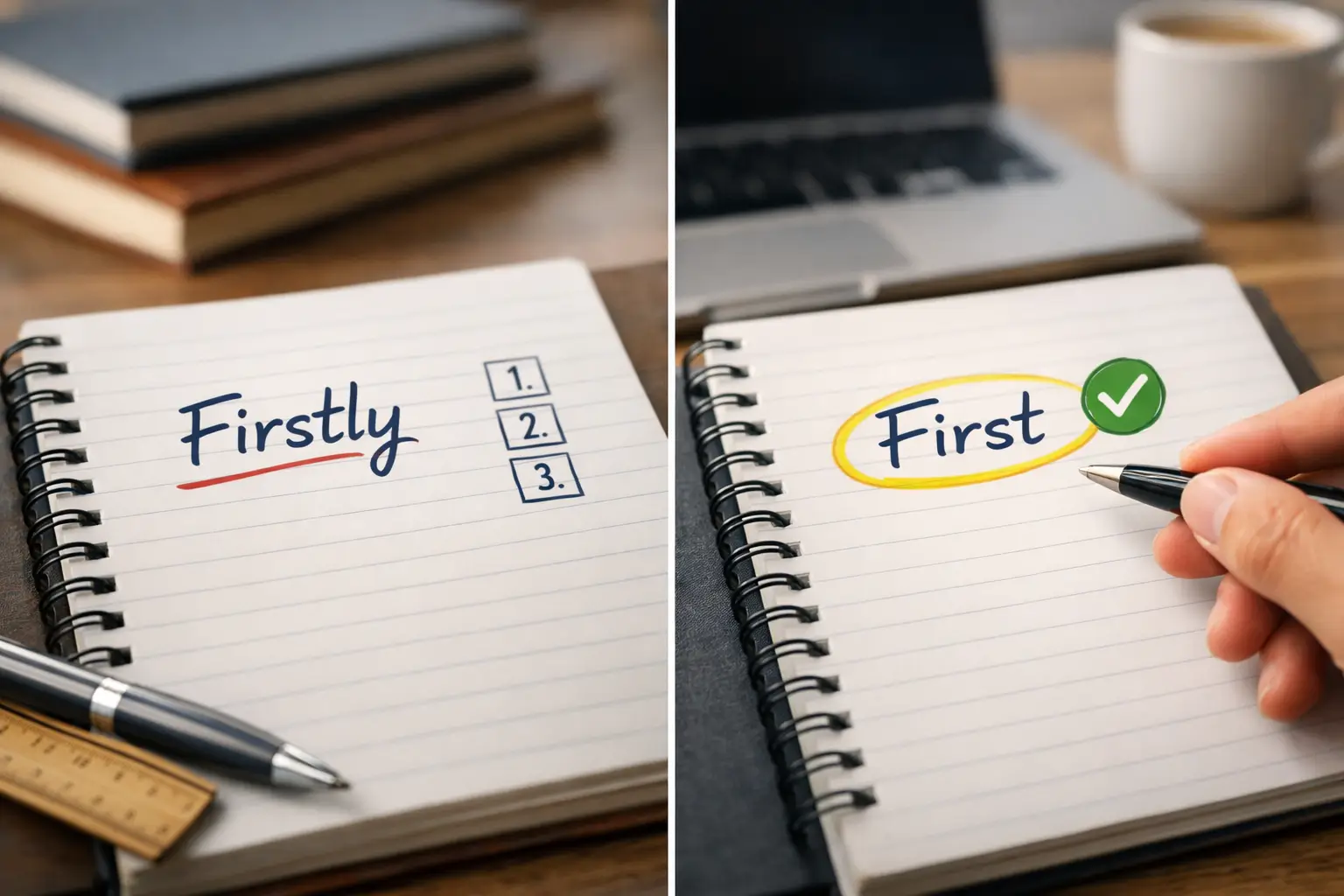
Have you ever stopped while writing and thought: Should I use “first” or “firstly”? This is a common question for students, writers, and professionals. Both words seem correct, and in many cases, they are. But choosing the right one can make your writing sound more natural and clear.
- First is more common and natural
- Firstly is more formal and often used in lists
People search for “first or firstly” because they want to sound correct in essays, emails, or presentations. The confusion comes from grammar rules and style choices. Some teachers prefer “first,” while others accept both.
In this guide, you will learn the difference in a simple way. You will see examples, rules, and tips. By the end, you will know exactly when to use “first” and when to use “firstly” with confidence.
First or Firstly – Quick Answer
First
- Meaning: Comes before everything else
- Use: More common in everyday English
Examples:
- First, we need to plan the project.
- I met her first at school.
Firstly
- Meaning: Used to introduce the first point in a list
- Use: More formal or structured writing
Examples:
- Firstly, we should check the data.
- Firstly, let’s understand the problem.
Quick Tip
Use first in most cases.
Use firstly when writing formal lists or speeches.
The Origin of First or Firstly
The word “first” comes from Old English fyrst, meaning “before all others.” It has been used for centuries in both speech and writing.
The word “firstly” was formed later by adding -ly, a suffix used to create adverbs (like quickly, slowly).
In older English, writers often used:
- firstly
- secondly
- thirdly
But over time, many style guides started to prefer:
- first
- second
- third
Why? Because “first” already works as both an adjective and an adverb. So adding “-ly” is not always needed.
British English vs American English Spelling
There is no spelling difference between British and American English. However, there is a style difference.
- American English: prefers “first”
- British English: accepts both, but “first” is still more common
Comparison Table
| Form | Meaning | Example | US English | UK English |
| First | General use, natural | First, we begin | Preferred | Preferred |
| Firstly | Formal listing | Firstly, we begin | Less common | Acceptable |
Which Spelling Should You Use?
Use “First” When:
- Writing emails or blogs
- Speaking in daily conversation
- You want simple and clear language
Example:
First, we will discuss the plan.
Use “Firstly” When:
- Writing formal essays
- Giving structured speeches
- Listing multiple points (firstly, secondly, thirdly)
Example:
Firstly, we must review the results.
Audience-Based Advice
- US audience: Use “first”
- UK/Commonwealth: Both are fine, but “first” is safer
- Global writing: Choose “first” for clarity and simplicity
Common Mistakes with First or Firstly
Mistake 1: Mixing styles
❌ Firstly, we start. Second, we continue.
✔ Firstly, we start. Secondly, we continue.
✔ First, we start. Second, we continue.
Mistake 2: Overusing “firstly”
❌ Firstly, I woke up. Firstly, I ate.
✔ First, I woke up. Then, I ate.
Mistake 3: Using “firstly” alone
❌ Firstly, we begin. (and no second point)
✔ First, we begin.
First or Firstly in Everyday Examples
Emails
- First, please check the file.
- Firstly, review the document carefully.
News Writing
- First, the government announced new rules.
- Firstly, experts analyzed the data.
Social Media
- First, watch this video!
- Firstly, let me explain this trend.
Formal Writing
- First, we examine the theory.
- Firstly, we define key terms.
First or Firstly – Google Trends & Usage Data
The keyword “first or firstly” is widely searched across the world.
Why People Search This
- Students writing essays
- Professionals writing reports
- ESL learners improving grammar
Popular Regions
- United States
- United Kingdom
- India
- Pakistan
Usage Insight
- “First” is used more in modern English
- “Firstly” appears in formal or academic writing
Search trends show that simple language is becoming more popular. That is why “first” is used more often today.
Comparison Table (Side-by-Side)
| Feature | First | Firstly |
| Type | Adjective/Adverb | Adverb |
| Usage | Common, everyday | Formal, structured |
| Tone | Simple | Formal |
| Example | First, we begin | Firstly, we begin |
| Popularity | High | Lower |
FAQs About First or Firstly
1. Is “firstly” correct English?
Yes, it is correct, but less common than “first.”
2. Which is better: first or firstly?
“First” is better for most situations because it is simple and natural.
3. Can I use “firstly” in essays?
Yes, especially in formal or academic writing.
4. Should I say “firstly” without “secondly”?
No, it’s better to use “first” if there is no list.
5. Why do people avoid “firstly”?
Because “first” already works well, so “firstly” can feel unnecessary.
6. Is there a difference in meaning?
No big difference. The main difference is style and tone.
7. Is “firstly” old-fashioned?
It can sound formal or slightly old-fashioned in casual writing.
Conclusion
The choice between “first” and “firstly” is not about right or wrong—it is about style. Both are correct, but they are used in different ways. “First” is simple, modern, and widely used in everyday English. It works in almost all situations, from emails to conversations.
On the other hand, “firstly” is more formal. It is useful when you are writing structured content like essays, reports, or speeches. It helps organize ideas clearly, especially when you also use “secondly” and “thirdly.”
If you are unsure, the safest choice is “first.” It sounds natural and clear to all readers. Over time, you will get a feel for when “firstly” fits better.
In short, keep your writing simple. Use “first” for clarity, and use “firstly” only when you need a formal tone. This small choice can make your writing stronger and more professional.
Learn more related article:
Incidents or Incidences: Which Is Correct? (guide 2026)

Evan L. Morwick is an English grammar writer and usage analyst.
He works in orthography, lexicography, and grammatography, focusing on common errors.
His articles explain spelling, word choice, and sentence clarity.
Evan helps learners write accurate, modern English.