Many people get confused between indescribable or undescribable. Both words look correct. Both sound correct. And both appear in dictionaries. So why do people keep searching for this keyword?
The confusion happens because English allows more than one prefix to mean “not.” Writers see in-, un-, and de- used in different words and assume they can be mixed freely.
Spellcheck often accepts both words, which makes the problem worse. As a result, people are unsure which word sounds natural and professional.
In real life, this confusion shows up in emails, essays, novels, social media posts, and even marketing copy. A sentence like “The feeling was indescribable” sounds natural.
But “The feeling was undescribable” sounds strange to many readers, even though it is technically correct.
This article clears up that confusion. You will learn the real difference between indescribable and undescribable, where both words come from, how British and American English treat them, and which one you should use to sound fluent and confident.
Indescribable or Undescribable – Quick Answer
Indescribable = correct, common, and preferred
Example: The beauty of the place was indescribable.
Undescribable = grammatically correct but rare
Example: The pain was undescribable.
Quick rule:
If you want natural English → use indescribable
The Origin of Indescribable or Undescribable
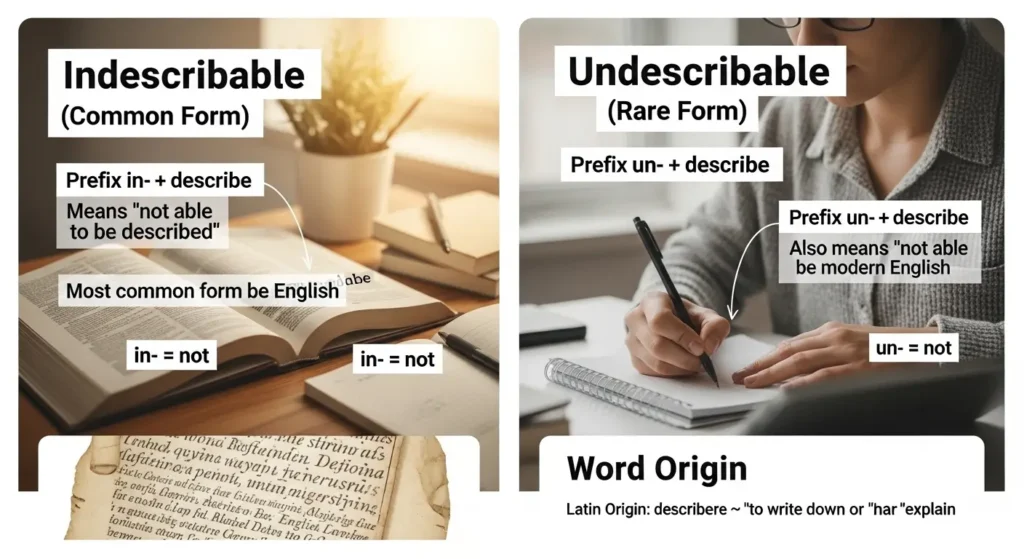
Both words are built from the verb describe, which comes from Latin describere, meaning “to write down” or “to explain.”
Indescribable uses the prefix in-, which means “not.” This prefix is very common in English and often changes form for smooth pronunciation.
Undescribable uses the prefix un-, which also means “not.” This prefix is usually added to adjectives and participles.
Both formations are technically correct. However, English usage over time favored indescribable. Writers, speakers, and publishers consistently chose it, making it the dominant form.
Language is shaped by use, not just rules. That is why indescribable became standard while undescribable faded into the background.
British English vs American English Spelling
There is no spelling difference between British and American English for these words. The difference is about preference, not location.
| Word | British English | American English |
| indescribable | very common | very common |
| undescribable | very rare | very rare |
In both varieties, indescribable is strongly preferred.
Which Spelling Should You Use?
US audience:
Always use indescribable. It sounds natural and professional.
UK/Commonwealth audience:
Again, indescribable is the safe and expected choice.
Global writing:
For blogs, academic writing, SEO content, and business communication, indescribable is best.
Use undescribable only if you are intentionally choosing a rare or stylistic form. For most writers, there is no reason to do that.
Common Mistakes with Indescribable or Undescribable
❌ The joy was undescribable
✅ The joy was indescribable
❌ An undescribable feeling of peace
✅ An indescribable feeling of peace
❌ Thinking undescribable is more correct
✅ Indescribable is the standard form
❌ Mixing prefixes randomly
✅ Follow common usage, not just grammar rules
Indescribable or Undescribable in Everyday Examples
Email:
The support I received was indescribable.
News:
Witnesses described an indescribable scene.
Social media:
This sunset is indescribable.
Formal writing:
The experience created an indescribable emotional impact.
Creative writing:
She felt an indescribable mix of fear and hope.
Indescribable or Undescribable – Google Trends & Usage Data
Search data shows that indescribable is searched far more often than undescribable. Interest is strong in English-speaking countries like the United States, the United Kingdom, Canada, Australia, and India.
Most searches come from people asking:
- Is undescribable a word?
- Which one is correct?
- Why does undescribable sound wrong?
Indescribable appears frequently in books, articles, songs, and online content. Undescribable appears very rarely and usually in older texts or experimental writing.
For SEO and clarity, indescribable clearly wins.
Indescribable vs Undescribable: Comparison Table
| Word | Correctness | Frequency | Recommended Use |
| indescribable | correct | very high | yes |
| undescribable | correct | very low | no (usually) |
FAQs About Indescribable or Undescribable
1. Is undescribable a real word?
Yes, but it is rarely used.
2. Which word sounds more natural?
Indescribable.
3. Do dictionaries accept both?
Yes, but they note usage differences.
4. Is there a meaning difference?
No, the meaning is the same.
5. Should I use undescribable in essays?
No, use indescribable.
6. Is this a British vs American issue?
No, both prefer indescribable.
7. Which is better for SEO writing?
Indescribable.
Conclusion
The choice between indescribable or undescribable may seem small, but it matters for clear and natural English. While both words are technically correct, only one is widely accepted and expected in modern writing.
Indescribable is the standard form. It is common, natural, and professional. It appears in everyday speech, formal writing, literature, and online content. Undescribable, while real, is rare and often sounds awkward to readers.
There is no difference between British and American English here. The rule stays the same across regions. If your goal is clarity, confidence, and correct usage, indescribable is always the better choice.
When in doubt, follow common usage, not just grammar logic. English rewards familiarity. Choose the word readers recognize and trust.
Learn more related article:
Knives or Knifes: Which Plural Is Correct?