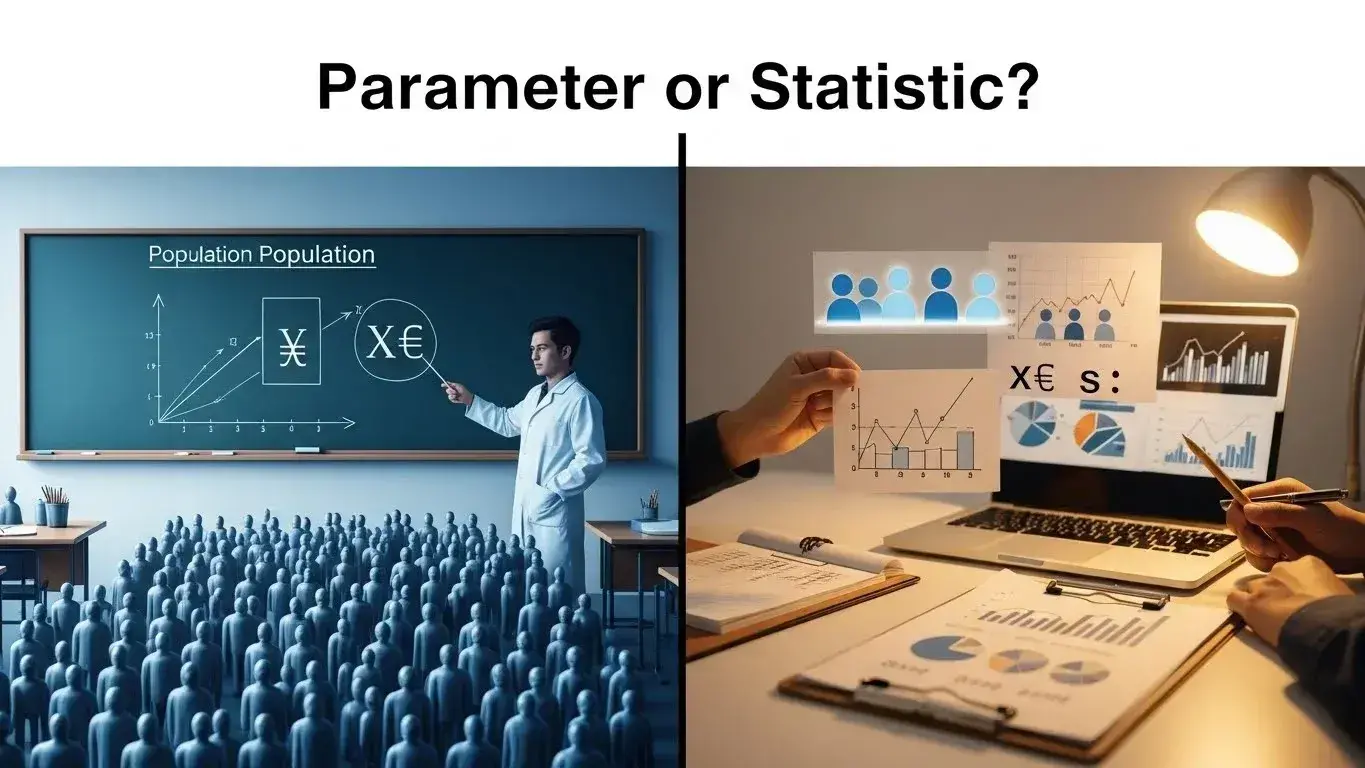
Have you ever read a sentence like “The parameter shows the average income” and wondered if statistic would be more correct? You are not alone.
Many students, researchers, analysts, and even professionals search for “parameter or statistic” because these two terms look similar and are often used in the same context. Both appear in math, data analysis, research papers, and reports, which adds to the confusion.
The problem is not spelling. The confusion comes from meaning and usage. A parameter and a statistic are closely related, but they are not the same thing.
Using the wrong one can change the meaning of your sentence and weaken your academic or professional writing.
This article solves that confusion step by step. First, you will get a clear and quick answer. Then you will learn the origin of both terms, how they are used in British and American English, common mistakes people make, and real-life examples.
Parameter or Statistic – Quick Answer
A parameter describes a whole population.
A statistic describes a sample taken from that population.
Examples:
- The average height of all adults in a country is a parameter.
- The average height of 500 surveyed adults is a statistic.
Simple rule:
Population → parameter
Sample → statistic
The Origin of Parameter or Statistic
The word parameter comes from Greek roots meaning measure beside or limit. Over time, it became a mathematical term used to describe fixed values that define a system or population.
The word statistic comes from the Latin status, meaning state. It was first used to describe data about governments and populations. Later, it became a core term in mathematics and data science to describe values calculated from samples.
There is no spelling difference here. The distinction exists because these words developed to describe different roles in data analysis. One represents the full truth (parameter), and the other represents an estimate (statistic).
British English vs American English Spelling
There is no spelling difference between British and American English for these words.
Both regions use:
- parameter
- statistic
The difference is based on concept, not region.
Comparison Table
| Term | British English | American English | Difference |
|---|---|---|---|
| Parameter | Parameter | Parameter | Meaning-based |
| Statistic | Statistic | Statistic | Meaning-based |
Which Spelling Should You Use?
Your choice depends on what you are describing, not who you are writing for.
- US audience: Use the correct term based on meaning.
- UK/Commonwealth: Same rule applies.
- Global audience: Meaning matters more than region.
Ask yourself one question:
Am I talking about the entire population or just a sample?
- Entire population → parameter
- Sample data → statistic
This rule works in all countries and all types of writing.
Common Mistakes with Parameter or Statistic
❌ The statistic of the whole population is known.
✅ The parameter of the whole population is known.
❌ This parameter is calculated from a small sample.
✅ This statistic is calculated from a small sample.
❌ Statistics and parameters mean the same thing.
✅ They are related but not the same.
Tip:
If data comes from a survey or sample, it is almost always a statistic.
Parameter or Statistic in Everyday Examples
Emails:
- Please calculate the statistic from last month’s survey.
News:
- Experts estimated population values using sample statistics.
Social Media:
- Poll results are just statistics, not full population truth.
Formal Writing:
- The population mean is an unknown parameter.
- The sample mean is a statistic used to estimate it.
Education:
- Students often confuse parameter with statistic.
Parameter or Statistic – Google Trends & Usage Data
Search trends show that:
- Statistic is searched more often by the general public.
- Parameter is searched more in academic and technical fields.
High interest appears in:
- United States
- United Kingdom
- India
- Pakistan
Most users search this keyword to understand exam questions, research methods, or data analysis concepts. This shows strong educational and professional intent.
Parameter or Statistic Comparison Table
| Feature | Parameter | Statistic |
|---|---|---|
| Describes | Whole population | Sample |
| Known value | Usually unknown | Calculated from data |
| Used in | Theory, models | Surveys, experiments |
| Example | Population mean (μ) | Sample mean (x̄) |
| Accuracy | Exact | Estimate |
FAQs About Parameter or Statistic
1. Is a parameter always fixed?
Yes. It represents a true population value.
2. Is a statistic an estimate?
Yes. It estimates a parameter.
3. Can a statistic become a parameter?
No. They serve different roles.
4. Are parameters used in real life?
Yes, but they are often unknown.
5. Are statistics less accurate than parameters?
They are estimates, so they have some error.
6. Do British and American textbooks differ here?
No. The definitions are the same.
7. Which is more common in daily language?
Statistic is more common outside academics.
Learn more: Acceptions or Exceptions: Which Word Is Correct ?
Conclusion
The confusion between parameter or statistic is very common, but the solution is simple once you understand the core idea. A parameter describes an entire population and represents the true value. A statistic describes a sample and helps estimate that true value. They are closely connected, but they are not interchangeable.
This difference matters in exams, research papers, data reports, and professional analysis. Using the wrong term can change meaning and reduce clarity. The good news is that the rule works everywhere. There is no British or American spelling issue, and no exception based on formality.
Whenever you feel unsure, remember this: population equals parameter, sample equals statistic. Keep that in mind, and your writing and analysis will become clearer, more accurate, and more professional.

Lena Whitcroft is an English grammar specialist and language writer.
She focuses on spelling differences and sentence correctness.
Her articles are designed for global English learners.
Lena believes clear grammar leads to clear communication.