Have you ever paused while writing and wondered whether it should be somber or sombre? You are not alone.
Many writers, students, bloggers, and professionals search for this keyword because both spellings look correct and both appear in books, news, and online articles.
The confusion grows when spellcheck accepts one spelling but flags the other, depending on your language settings.
The issue is not about meaning. Both words describe the same feeling: something serious, dark, quiet, or sad.
The real confusion comes from English spelling differences across regions. British English and American English often spell the same word in different ways, and somber/sombre is a classic example.
This article solves that confusion clearly and simply. You will learn which spelling is used in which country, where the word comes from, and how to choose the right form for your audience.
We will also show common mistakes, real-life examples, search trends, and easy tips to remember the correct usage. By the end, you will know exactly when to use somber or sombre with confidence.
Somber or Sombre – Quick Answer
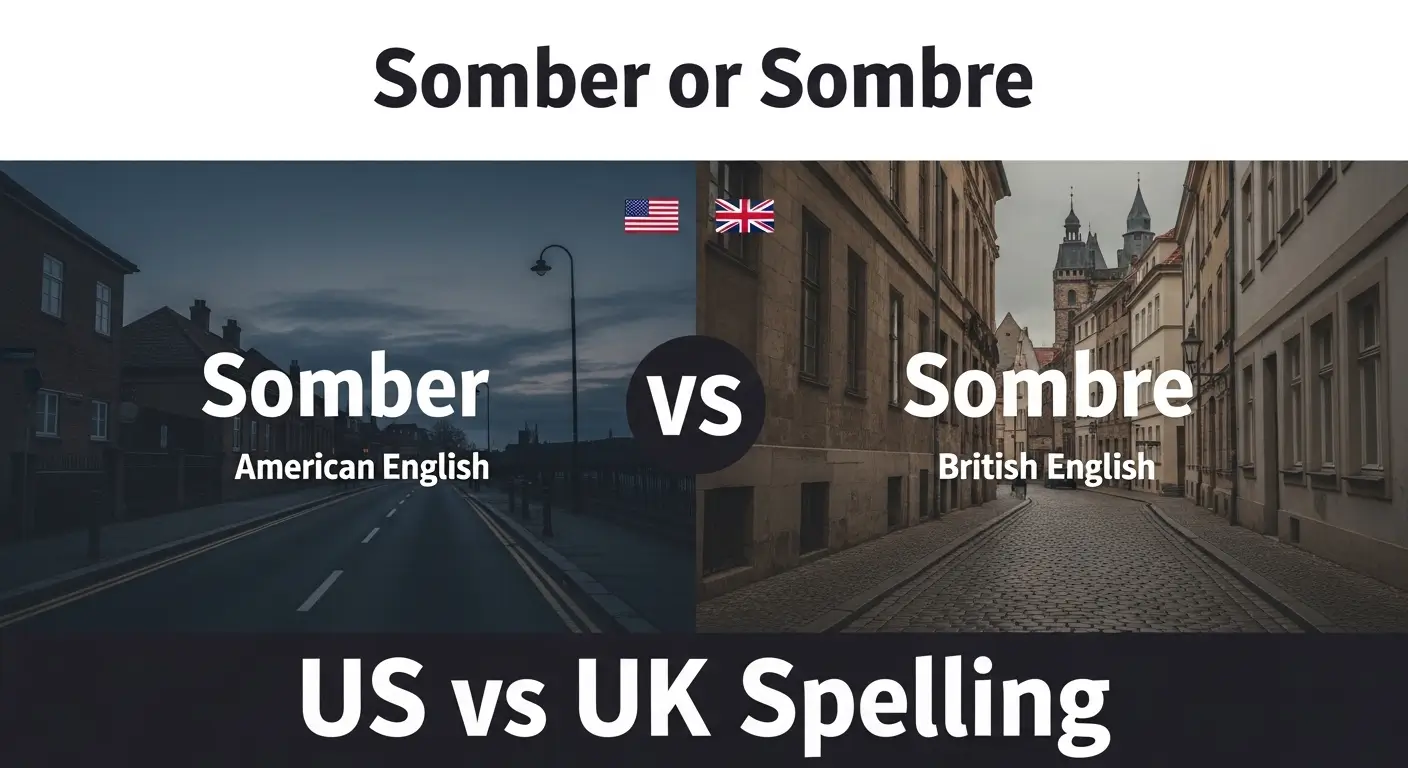
Both spellings are correct. The choice depends on location.
- Somber → American English
- Sombre → British English
They mean the same thing: serious, dark, gloomy, or sad.
Examples:
- The room felt somber after the news. (US)
- The ceremony had a sombre mood. (UK)
The Origin of Somber or Sombre
The word comes from Latin subumbrare, meaning “to shade.” It later passed into Old French as sombre, meaning dark or gloomy. British English kept the French spelling sombre.
When the word entered American English, spelling reforms simplified many words. Americans dropped the silent -re ending, turning sombre into somber. This pattern appears in many words, such as centre/center and theatre/theater.
So, the spelling difference exists because American English favors shorter, phonetic forms, while British English stays closer to French roots.
British English vs American English Spelling
This is a regional spelling difference, not a correctness issue.
Comparison Table
| Feature | Somber | Sombre |
| Meaning | Dark, serious | Dark, serious |
| American English | ✅ Correct | ❌ Rare |
| British English | ❌ Rare | ✅ Correct |
| Canadian English | ⚠ Mixed | ⚠ Mixed |
| Australian English | ❌ Rare | ✅ Correct |
Which Spelling Should You Use?
Choose based on your audience.
- US audience: Use somber
- UK/Commonwealth audience: Use sombre
- Global audience: Either is fine, but be consistent
If you are writing for SEO, blogs, or international readers, pick one style and stick to it throughout the content.
Common Mistakes with Somber or Sombre
Here are frequent errors writers make:
❌ Mixing both spellings in one article
✅ Choose one spelling and stay consistent
❌ Thinking one spelling is wrong
✅ Both are correct, region matters
❌ Using the wrong spelling for the audience
✅ Match spelling to reader location
Tip: Check your audience’s country before publishing.
Somber or Sombre in Everyday Examples
Emails
- The meeting ended on a somber note. (US)
- The report struck a sombre tone. (UK)
News
- A somber crowd gathered downtown.
- The nation observed a sombre silence.
Social Media
- Today feels somber
- A sombre reminder of history.
Formal Writing
- The author adopts a somber style.
- The speech carried a sombre mood.
Somber or Sombre – Google Trends & Usage Data
Search data shows clear regional patterns:
- Somber is more popular in:
- United States
- SEO blogs
- Online media
- Sombre is more popular in:
- United Kingdom
- Australia
- British publications
Many users search “somber or sombre” to confirm which spelling fits their writing. The intent is spelling clarity, not meaning.
Comparison Table: Somber vs Sombre
| Aspect | Somber | Sombre |
| Correct spelling | ✅ Yes | ✅ Yes |
| Meaning difference | ❌ None | ❌ None |
| US English | ✅ Standard | ❌ Rare |
| UK English | ❌ Rare | ✅ Standard |
| Formal writing | ✅ Yes | ✅ Yes |
| SEO usage | ✅ High | ⚠ Regional |
FAQs: Somber or Sombre
1. Is somber or sombre more correct?
Both are correct. Region decides.
2. Do they have different meanings?
No. The meaning is the same.
3. Can I use sombre in American writing?
Yes, but somber is preferred.
4. Which spelling is better for SEO?
Use the one your target audience searches.
5. Is sombre used in Canada?
Canada uses both, but British spelling is common.
6. Is one more formal than the other?
No. Both are equally formal.
7. Should I mix both spellings?
No. Always stay consistent.
Conclusion
The debate over somber or sombre is not about right or wrong. It is about where you are writing and who you are writing for. Both spellings describe the same feeling of seriousness, sadness, or darkness. The difference comes from regional spelling rules.
American English prefers somber, while British and Commonwealth English prefer sombre. This difference traces back to French roots and later spelling simplifications in the United States. Understanding this history makes the choice easier and more logical.
For clear and professional writing, always match your spelling to your audience. If your readers are in the US, choose somber. If they are in the UK or Australia, choose sombre. For global content, either works, but consistency is key. Once you follow this simple rule, you will never hesitate over somber or sombre again.
Learn more related article:
Incidents or Incidences: Which Is Correct? (guide 2026)

Evan L. Morwick is an English grammar writer and usage analyst.
He works in orthography, lexicography, and grammatography, focusing on common errors.
His articles explain spelling, word choice, and sentence clarity.
Evan helps learners write accurate, modern English.