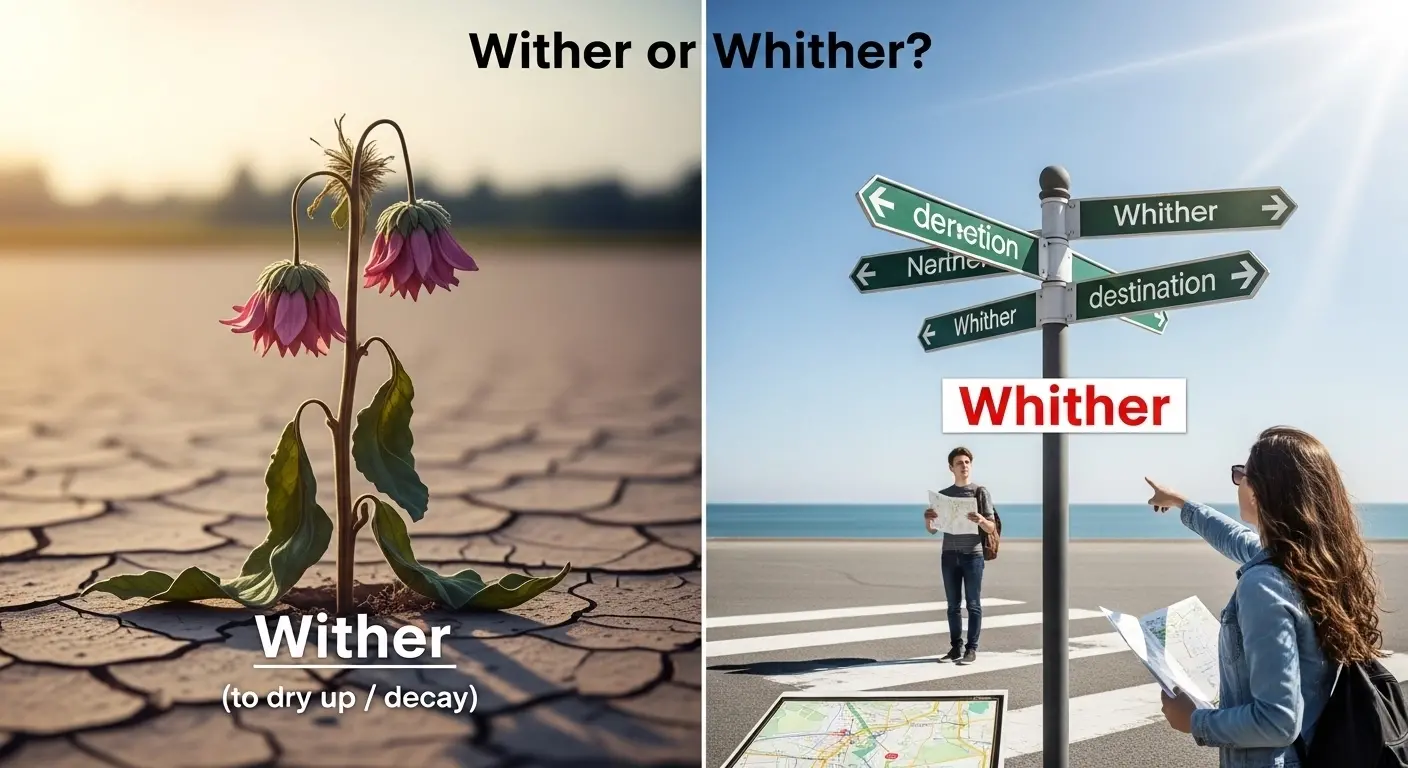
“Wither” means to dry up or lose strength, while “whither” is used to ask or indicate a direction or destination; both are correct words but have different meanings and uses.
Many English learners and even native speakers feel confused when they see or hear the words wither and whither.
These words look almost the same, sound similar, and are often mixed up in writing. Because of this, people frequently search for wither or whither to understand which word is correct and when to use it.
The confusion happens because both words are old English words and are not used equally in modern daily speech. One word is still common, while the other feels formal or old-fashioned.
When people read books, poetry, exams, or formal writing, they may see whither and think it is just another spelling of wither. This leads to mistakes in sentences and unclear meaning.
Using the wrong word can change the meaning of a sentence completely. One talks about decay, while the other talks about direction. This article clears that confusion.
You will learn the meaning, origin, correct usage, common mistakes, and practical examples of wither or whither, so you can use both words with confidence.
Wither or Whither – Quick Answer
Wither means to dry up, weaken, or decay.
Whither means to what place or where.
Examples:
The plant began to wither without water.
Whither are you going after school?
The Origin of Wither or Whither
The word wither comes from Old English witherian, meaning to dry up or lose strength. It has always been connected to plants, health, and decline. Over time, its meaning expanded to include emotions, hope, and power.
The word whither comes from Old English hwider, meaning toward what place. It was commonly used in older English to ask about direction or destination.
The spelling difference exists because these words developed from different roots. Even though they look similar today, their meanings were always separate. As English evolved, wither stayed common, while whither became rare and more formal.
British English vs American English Spelling
There is no spelling difference between British and American English for these words.
| Word | American English | British English |
| wither | Correct | Correct |
| whither | Correct | Correct |
The difference is not regional. It is based on meaning and usage.
Which Spelling Should You Use?
Choose the word based on what you want to say.
Use wither when talking about:
- Plants drying
- Health weakening
- Hope or power fading
Use whither when asking about:
- Direction
- Destination
- Where something is going
Audience advice:
- US audience: Avoid whither unless writing formally
- UK/Commonwealth: Same advice
- Global English: Prefer where instead of whither in casual writing
Common Mistakes with Wither or Whither
❌ The flowers will whither in the heat.
✅ The flowers will wither in the heat.
❌ Whither did his strength go over time?
✅ Wither did his strength go over time?
(or better: Where did his strength go?)
❌ Using whither instead of where in casual writing
✅ Use where for modern English
❌ Confusing wither with movement
✅ Wither is about decline, not direction
Wither or Whither in Everyday Examples
Emails:
His motivation seems to wither under pressure.
Whither should I send the documents?
News:
The crops may wither due to drought.
The article asks whither the economy is heading.
Social media:
Dreams wither without action.
Whither are we going as a society?
Formal writing:
The empire began to wither slowly.
The speech questioned whither progress would lead.
Wither or Whither – Google Trends & Usage Data
Search data shows:
- Wither is searched more often
- Whither appears mainly in academic, literary, and exam-related searches
By context:
- Education: Grammar and vocabulary lessons
- Literature: Poems, novels, classic texts
- Writing help: Formal vs modern English usage
Wither is widely used today.
Whither is niche and formal.
Wither vs Whither Comparison Table
| Feature | Wither | Whither |
| Meaning | Decay or weaken | Direction or destination |
| Part of speech | Verb | Adverb |
| Modern usage | Common | Rare |
| Formal tone | Neutral | Formal / old |
| Can replace “where” | No | Yes (formal) |
FAQs About Wither or Whither
1. Is whither still used today?
Yes, but mostly in formal or literary writing.
2. Can I use whither instead of where?
Only in formal English. In daily speech, use where.
3. Does wither only apply to plants?
No. It can describe health, emotions, or power.
4. Is wither a negative word?
Usually yes. It suggests decline or loss.
5. Are wither and whither homophones?
No. They sound similar but not the same.
6. Which word is more common?
Wither is much more common.
7. How can I remember the difference?
Wither = weaken. Whither = where.
Conclusion
The difference between wither or whither becomes clear once you focus on meaning. Wither talks about decline, decay, or loss of strength. Whither asks about direction or destination. They are not interchangeable, even though they look similar.
There is no difference between British and American English here. The rule stays the same worldwide. In modern English, wither is common and useful. Whither is rare and mostly used in formal writing, poetry, or older texts.
If you are writing emails, blogs, or casual content, avoid whither and use where instead. Use wither when describing something fading or weakening.
Understanding this difference improves clarity and makes your writing sound more confident and professional.
Learn about:
Critic or Critique: What’s the Difference ? (2026)

Evan L. Morwick is an English grammar writer and usage analyst.
He works in orthography, lexicography, and grammatography, focusing on common errors.
His articles explain spelling, word choice, and sentence clarity.
Evan helps learners write accurate, modern English.