The correct spelling is “dysregulated.” “Disregulated” and “disregulated” are incorrect spellings in standard English, especially in medical and psychological contexts. This quick answer clears up the main confusion right away.
Have you ever written “disregulated” and seen a red underline appear? Or read “dysregulated” in a medical article and wondered if it was just a fancy version of the same word? You are not alone.
Many people search for “dysregulated or disregulated” because the words look similar and sound close.
They often appear in psychology, medicine, education, and mental health writing. When you see them in serious articles, it can feel confusing.
The problem happens because English prefixes like dis- and dys- look similar but mean different things. The prefix dys- comes from Greek and means “bad,” “impaired,” or “abnormal.” That is why professionals use dysregulated in medical and emotional health contexts. Fast typing, spellcheck errors, and unfamiliar Greek words make the mistake more common.
For students, researchers, therapists, and writers, using the wrong spelling can hurt clarity and credibility. This article explains everything in simple language so you can use the correct word with confidence every time.
Dysregulated or Disregulated – Quick Answer
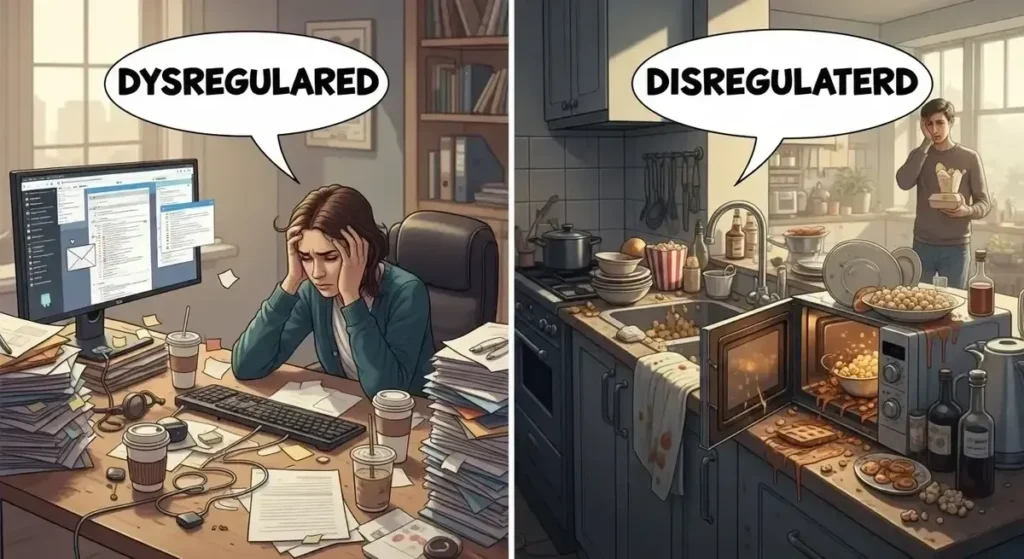
Dysregulated is the correct and standard spelling.
Disregulated is incorrect in modern English.
- Dysregulated means not properly regulated or out of balance.
- Disregulated is a common spelling mistake and is not accepted in dictionaries.
Examples:
- Stress can cause a dysregulated nervous system.
- The child shows dysregulated emotions.
Dysregulate Meaning:
Dysregulate means to disturb or impair proper regulation or balance.
Example:
Stress can dysregulate the nervous system.
The Origin of Dysregulated or Disregulated
The word dysregulated comes from two parts:
- dys- (Greek prefix) meaning bad, abnormal, or impaired
- regulated meaning controlled or managed
The prefix dys- appears in many medical and scientific words:
- dysfunction
- dyslexia
- dysphoria
The spelling disregulated comes from confusion with the prefix dis-, which means not or opposite of. While dis- is common in English, it is not used with regulated in this context.
Because dys- words often appear in technical fields, many people mishear or mistype them, leading to the incorrect form disregulated.
British English vs American English Spelling
There is no difference between dysregulated or disregulated uk & US english.
Both varieties use dysregulated only.
Comparison Table
| Variant | British English | American English |
|---|---|---|
| Dysregulated | ✅ Correct | ✅ Correct |
| Disregulated | ❌ Incorrect | ❌ Incorrect |
This is a meaning-based rule, not a regional one.
Which Spelling Should You Use?
The choice is simple:
- ✅ Use dysregulated spelling in all contexts
- ❌ Avoid disregulated spelling completely
Audience-based advice:
- US audience: Dysregulated
- UK/Commonwealth: Dysregulated
- Global or academic writing: Dysregulated
If you are writing for psychology, education, medicine, only dysregulated is acceptable.
Common Mistakes with Dysregulated vs Disregulated
Here are frequent errors and fixes of dis or dysregulated:
❌ The patient has a disregulated stress response.
✅ The patient has a dysregulated stress response.
❌Children become disregulated when tired.
✅ Children become dysregulated when tired.
❌ Disregulated emotions are common in anxiety.
✅ Dysregulated emotions are common in anxiety.
Tip:
If the word relates to health, behavior, or systems, the prefix is almost always dys-.
Dysregulated or Disregulated in Everyday Examples
Emails
- The team became dysregulated under pressure.
News
- Trauma can leave the nervous system dysregulated, experts say.
Social Media
- I feel emotionally dysregulated today.
Formal Writing
- Chronic stress leads to dysregulated hormonal activity.
In professional and academic writing, disregulated should never appear.
Dysregulated or Disregulated – Google Trends & Usage Data
Search data shows:
- Dysregulated is widely used in:
- Psychology
- Mental health
- Neuroscience
- Education
- Disregulated appears mostly in:
- Misspellings
- Auto-typed errors
- Low-quality content
Medical journals, textbooks, and trusted websites use dysregulated almost 100% of the time. Searches for “disregulated” often come from people checking if it is wrong.
Comparison Table: Dysregulated vs Disregulated
| Feature | Dysregulated | Disregulated |
|---|---|---|
| Correct spelling | ✅ Yes | ❌ No |
| Dictionary listed | ✅ Yes | ❌ No |
| Medical usage | ✅ Common | ❌ Not used |
| Academic writing | ✅ Accepted | ❌ Rejected |
| content safe | ✅ Yes | ❌ No |
FAQs: Dysregulated or Disregulated
1. Is dysregulated a real word?
Yes. Dysregulated is a real and accepted word, especially in medical and psychological contexts.
2. Why do people write disregulated?
People write disregulated or disregulated by mistake because the prefix dis- is common and sounds similar to dys-.
3. Is dysregulated a medical term?
Yes. It is widely used in medicine, psychology, and neuroscience to describe abnormal regulation in the body or brain.
4. Can dysregulated describe emotions?
Yes. The term emotional dysregulation is commonly used in mental health to describe difficulty managing emotions.
5. Is dysregulated used in British English?
Yes. It is used the same way in both British and American English.
6. What does dysregulated mean in simple words?
It means not balanced, not controlled, or not working properly.
7. Should I ever use disregulated?
No. Disregulated (or disregulated) is considered a spelling mistake in standard English.
8. How do you spell disregulated correctly?
The correct spelling is dysregulated.
9. Is disregulated a word?
No. Disregulated (or disregulated) is not the correct standard spelling. The accepted word is dysregulated.
Conclusion
The confusion between dysregulated or disregulated is very common, but the answer is clear. Dysregulated is the only correct spelling in modern English. It comes from the Greek prefix dys-, meaning abnormal or impaired, and it is widely used in medical, psychological, and academic writing.
The form disregulated looks logical at first, but it is not accepted by dictionaries . Using it can weaken your writing and make it seem less credible in technical contexts.
Once you know this, you can write with confidence and avoid a very common English mistake.
Learn more :
Gaurd or Guard: Which Spelling Is Correct?

Oliver Lexon focuses on English vocabulary clarity and usage accuracy. His writing breaks down confusing word pairs and grammar topics into simple explanations with real-life examples, making English easier for non-native speakers.