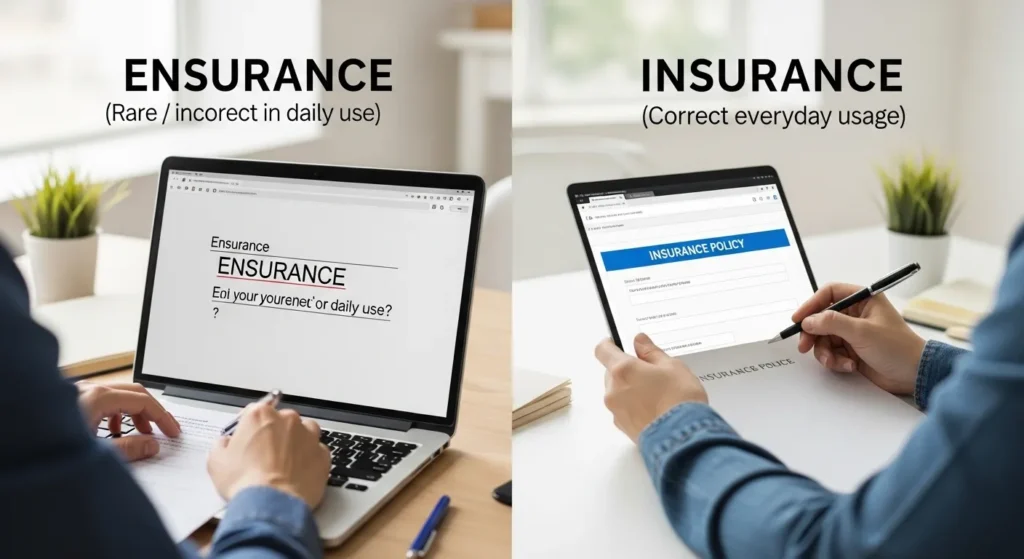
Many writers, students, and professionals feel confused between ensurance or insurance. Both words look similar. Both sound close.
Insurance is the correct and common word in modern English, while ensurance is rare and usually avoided.
People often search for ensurance or insurance when filling out forms, writing contracts, sending emails, or reading legal documents. They want to know which word sounds correct and professional.
The confusion happens because both words come from the same root and both relate to protection or certainty. Some dictionaries list ensurance as a real but rare word, while others barely mention it.
Spellcheck may not mark it as wrong, which makes the problem worse. Because of this, people use ensurance when they really mean insurance, especially in business or legal writing.
This article clears up that confusion in a simple way. You will get a quick answer first. Then you will learn the real meanings, word history, and clear usage rules. You will also see examples from daily life and professional writing.
By the end, you will know exactly which word to use and why insurance is almost always the right choice.
Ensurance or Insurance – Quick Answer
Insurance ✅ = correct and widely used
Ensurance ⚠️ = rare and usually unnecessary
Examples:
- She bought health insurance.
- The company offers car insurance.
Simple rule:
For protection, policies, or coverage → insurance
The Origin of Ensurance or Insurance
Both words come from the Latin root securus, meaning safe or secure. Over time, English borrowed related words from French.
- Insurance came from Old French assurer, meaning to protect or guarantee.
- Ensurance developed later as a variation but never became popular.
Historically, ensurance was sometimes used to mean making sure something happens. However, insurance became the standard word for financial protection, risk coverage, and legal policies. As industries grew, especially banking and law, insurance became the clear and accepted term.
Today, ensurance survives mainly in dictionaries and rare writing, but insurance dominates modern English.
British English vs American English Spelling
There is no spelling difference between British and American English for these words. Usage is the same in both regions.
| Word | British English | American English |
| insurance | ✅ standard | ✅ standard |
| ensurance | ⚠️ rare | ⚠️ rare |
Both regions strongly prefer insurance in all professional contexts.
Which Spelling Should You Use?
Use insurance when:
- Talking about health, car, home, or life coverage
- Writing contracts or legal documents
- Speaking about financial protection
Avoid ensurance unless:
- Writing historical or academic text
- Quoting an old source
Audience advice:
- US audience: Always use insurance
- UK/Commonwealth: Always use insurance
- Global audience: Insurance is clear and trusted
Tip:
If you are unsure, choose insurance. It is never wrong.
Common Mistakes with Ensurance or Insurance
❌ “I bought travel ensurance.”
✅ “I bought travel insurance.”
❌ “Health ensurance is required.”
✅ “Health insurance is required.”
❌ Thinking ensurance is more formal
✅ Insurance is the professional term
❌ Using ensurance in legal writing
✅ Use insurance only
Ensurance or Insurance in Everyday Examples
Email:
Please send me the insurance documents.
News:
Insurance costs are rising this year.
Social media:
Always get travel insurance.
Formal writing:
The policy includes full insurance coverage.
Business:
The firm provides employee insurance benefits.
Ensurance or Insurance – Google Trends & Usage Data
Google Trends shows:
- Insurance has extremely high global search volume
- Ensurance has very low search interest
Search interest in insurance is strong in:
- United States
- United Kingdom
- Canada
- Australia
Ensurance appears mainly in grammar searches, not real-world usage. This data confirms that insurance is the word people use and expect.
Ensurance vs Insurance: Comparison Table
| Word | Meaning | Usage |
| insurance | financial protection | standard |
| ensurance | assurance or certainty | rare |
FAQs About Ensurance or Insurance
1. Is ensurance a real word?
Yes, but it is rarely used.
2. Is ensurance wrong in contracts?
Yes, insurance should be used.
3. Do dictionaries accept ensurance?
Some do, but note it as uncommon.
4. Is insurance always correct?
Yes, in modern usage.
5. Can ensurance replace insurance?
No, not in professional writing.
6. Why do people confuse them?
They look and sound similar.
7. Which word should ESL learners use?
Insurance.
Conclusion
The difference between ensurance or insurance is simple in modern English. Insurance is the correct, standard, and professional word used worldwide. It refers to protection, coverage, and risk management. Ensurance, while technically real, is outdated and rarely needed.
Using ensurance instead of insurance can confuse readers and make writing look unprofessional. This matters even more in legal, financial, and business contexts. Clear language builds trust, and insurance does exactly that.
For everyday writing, emails, forms, and official documents, always choose insurance. It is safe, correct, and universally understood. Once you know this rule, you will never hesitate again. Choosing the right word improves clarity, credibility, and confidence in your writing.
Learn more about:
Me or Myself: Correct Usage Guide

Lena Whitcroft is an English grammar specialist and language writer.
She focuses on spelling differences and sentence correctness.
Her articles are designed for global English learners.
Lena believes clear grammar leads to clear communication.