

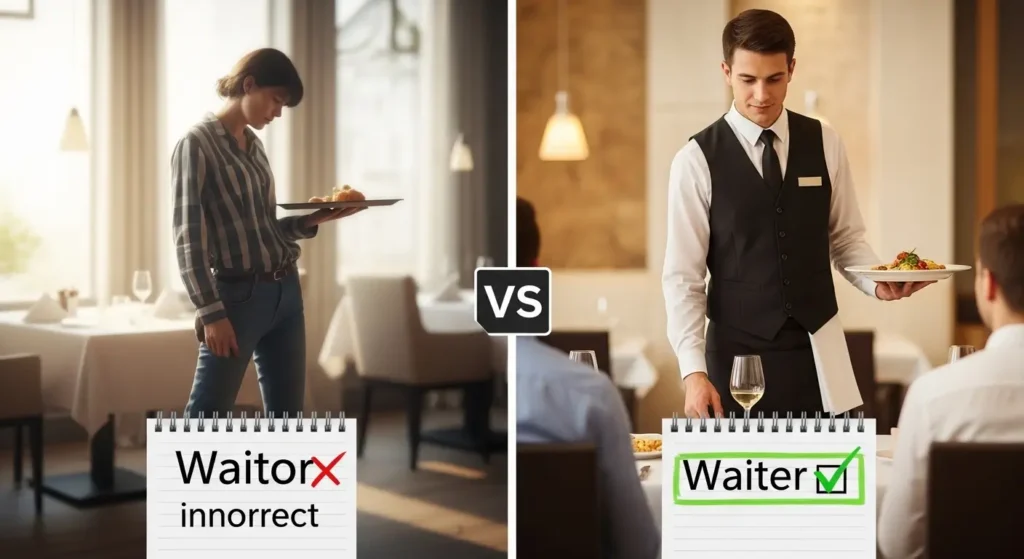
Have you ever typed “waitor” and wondered if it’s correct? You are not alone. Many people get confused between “waitor” and “waiter” because both look similar and sound the same when spoken.
- Waiter = correct spelling
- Waitor = incorrect spelling
People search for “waitor or waiter” because English spelling rules can be tricky. Sometimes words sound one way but are spelled differently. This creates confusion, especially for students and non-native speakers.
In this guide, you will learn the correct spelling, its origin, and how to use it properly. You will also see examples, common mistakes, and tips to avoid errors. By the end, you will never confuse “waitor” and “waiter” again.
Waitor or Waiter – Quick Answer
Waiter (Correct)
- Meaning: A person who serves food in a restaurant
- Example: The waiter brought our drinks.
Waitor (Incorrect)
- Meaning: No meaning in standard English
- Example: ❌ The waitor took our order.
Quick Tip
Always use “waiter” with -er at the end.
The Origin of Waitor or Waiter
The word “waiter” comes from the Old French word waitier, meaning “to watch or attend.” It later entered English and came to mean someone who serves guests.
The ending “-er” is common in English for people who perform actions:
- teach → teacher
- work → worker
- wait → waiter
The spelling “waitor” likely comes from confusion with words ending in “-or” (like actor, doctor). But in this case, that rule does not apply.
British English vs American English Spelling
There is no difference between British and American English for this word.
Both use:
- ✅ waiter
- ❌ waitor
Comparison Table
| Form | Meaning | Example | US English | UK English |
| Waiter | Person serving food | The waiter smiled | Correct | Correct |
| Waitor | Incorrect spelling | The waitor smiled | Wrong | Wrong |
Which Spelling Should You Use?
Always Use “Waiter”
- In school writing
- In emails and formal texts
- In everyday conversation
Example:
The waiter took our order quickly.
Avoid “Waitor”
- It is not a real English word
- It may make your writing look incorrect
Audience-Based Advice
- US audience: Use “waiter”
- UK/Commonwealth: Use “waiter”
- Global writing: Only “waiter” is correct
Common Mistakes with Waitor or Waiter
Mistake 1: Using “waitor”
❌ The waitor served food.
✔ The waiter served food.
Mistake 2: Confusing with “actor” or “doctor”
❌ Waitor (because of -or ending)
✔ Waiter (correct form)
Mistake 3: Spelling errors in typing
❌ Waetor / Waitor
✔ Waiter
Waitor or Waiter in Everyday Examples
Emails
- The waiter was very polite.
News Writing
- The waiter helped customers during the event.
Social Media
- Our waiter gave great service today!
Formal Writing
- The waiter ensured all guests were comfortable.
Waitor or Waiter – Google Trends & Usage Data
The keyword “waitor or waiter” is commonly searched online.
Why People Search This
- Confusion about spelling
- Learning English vocabulary
- Writing correctly in exams or jobs
Popular Regions
- United States
- United Kingdom
- India
- Pakistan
Usage Insight
- “Waiter” is widely used worldwide
- “Waitor” appears only as a spelling mistake
Search trends clearly show that “waiter” is the standard and accepted spelling.
Comparison Table (Side-by-Side)
| Feature | Waiter | Waitor |
| Correctness | ✅ Correct | ❌ Incorrect |
| Meaning | Person serving food | No meaning |
| Usage | Common worldwide | Not used |
| Ending | -er | -or |
| Example | The waiter helped us | ❌ Not correct |
FAQs About Waitor or Waiter
1. Is “waitor” a real word?
No, “waitor” is not a correct English word.
2. What is the correct spelling?
The correct spelling is “waiter.”
3. Why do people write “waitor”?
Because they confuse it with words like “actor” or “doctor.”
4. Is “waiter” used in both UK and US English?
Yes, it is used in both.
5. What is the female form of waiter?
“Waitress,” though “server” is now commonly used for both genders.
6. Can I use “waitor” in informal writing?
No, it is always incorrect.
7. What is a modern alternative to “waiter”?
“Server” is often used in restaurants today.
Conclusion
The difference between “waitor” and “waiter” is simple but important. Only one of these words is correct, and that is “waiter.” The spelling “waitor” is a common mistake and should always be avoided.
Understanding this difference helps you write clearly and professionally. Whether you are writing an email, posting on social media, or completing school work, using the correct spelling makes a strong impression.
A good way to remember this is to focus on the “-er” ending. Many English words that describe a person’s job end in “-er,” such as “teacher” or “worker.” “Waiter” follows the same rule.
In modern English, you may also hear the word “server,” which is gender-neutral and widely accepted. Still, “waiter” remains correct and common.
Keep practicing correct spelling, and soon it will feel natural. Small details like this can make a big difference in your writing quality.