

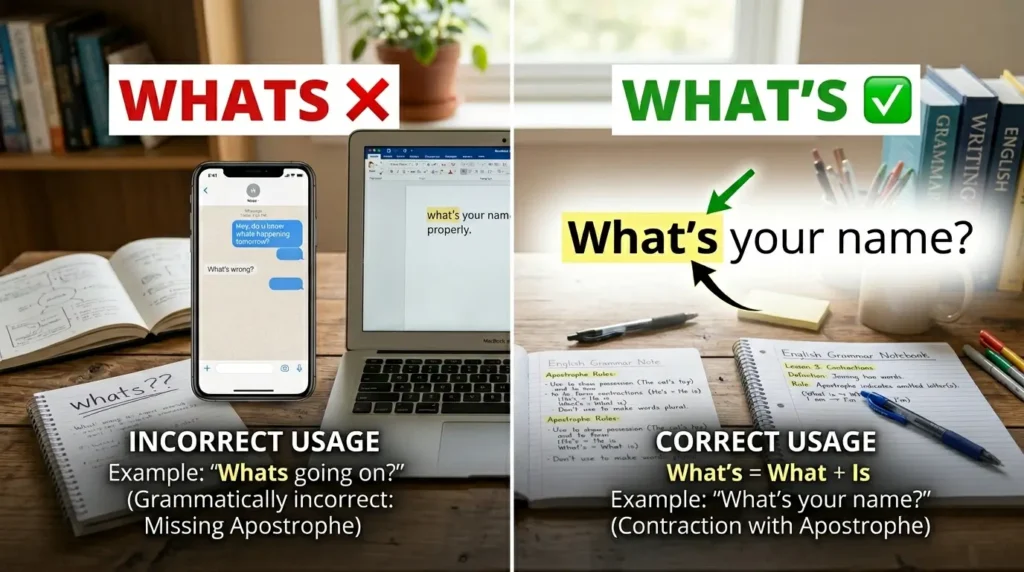
“What’s” is the correct spelling in standard English when you mean “what is” or “what has.” “Whats” without the apostrophe is usually incorrect unless it appears in informal texting, usernames, or brand names.
English punctuation can completely change the meaning of a word. One small apostrophe often creates big confusion, and that is exactly what happens with “whats” or “what’s.” These two forms look almost identical, but only one is grammatically correct in normal English writing.
People search for “whats or what’s” because the mistake appears everywhere. It shows up in social media captions, text messages, emails, blog posts, and even professional documents. Since people type quickly online, apostrophes are often skipped. Over time, many writers become unsure which form is actually correct.
The confusion happens because spoken English does not show punctuation. When someone says “what’s,” you hear only the sound, not the apostrophe. Autocorrect and casual texting habits also encourage people to drop punctuation completely.
Using the wrong form may make writing appear careless or unprofessional. This article explains the difference clearly and simply. You will learn the correct spelling, the origin of the word, common mistakes, grammar rules, real-life examples, and how English speakers use the term today. By the end, you will confidently know when to use “what’s” and when “whats” is incorrect.
Whats or What’s – Quick Answer
What’s = Correct
“What’s” is a contraction of:
- what is
- what has
Examples:
- What’s your favorite movie?
- What’s happened here?
Whats = Usually Incorrect
“Whats” without an apostrophe is not standard English.
❌ Whats your problem?
✅ What’s your problem?
Simple rule:
- Need “what is” or “what has”? → use “what’s”
- No apostrophe? → usually incorrect
The Origin of Whats or What’s
The word “what” comes from Old English hwæt, which was used to ask questions or request information. Over time, English speakers began combining “what” with helping verbs like “is” and “has.”
This created the contraction:
- what + is = what’s
- what + has = what’s
English contractions became common because they made speech faster and smoother. Apostrophes were added to show missing letters.
Examples:
- do not → don’t
- it is → it’s
- what is → what’s
The spelling “whats” appeared much later because of informal typing habits, texting culture, and social media shortcuts. However, standard grammar rules still require the apostrophe.
British English vs American English Spelling
There is no spelling difference between British and American English.
| English Variant | Correct Form |
| British English | what’s |
| American English | what’s |
| Incorrect Form | whats |
Both forms of English follow the same punctuation rule.
Which Spelling Should You Use?
US Audience
Use “what’s” in all formal and informal writing.
UK and Commonwealth Audience
Use “what’s” exactly the same way.
Global English
“What’s” is accepted worldwide.
Only use “whats” in:
- usernames
- hashtags
- casual texting
- branding
Example:
- #whatsgood
Even in these cases, it is stylistic rather than grammatical.
Common Mistakes with Whats or What’s
Here are the most common errors writers make.
| Incorrect | Correct |
| Whats your name? | What’s your name? |
| Whats happening? | What’s happening? |
| Whats the time? | What’s the time? |
| Whats wrong with him? | What’s wrong with him? |
Why This Mistake Happens
- Fast typing
- Ignoring apostrophes online
- Informal texting habits
- Pronunciation confusion
Easy Memory Trick
If you can replace the word with “what is” or “what has,” use “what’s.”
Example:
What’s your plan?
= What is your plan?
The sentence still works, so “what’s” is correct.
Whats or What’s in Everyday Examples
Emails
What’s the meeting schedule for tomorrow?
News
What’s causing the increase in prices?
Social Media
What’s everyone doing tonight?
Formal Writing
What’s important is the quality of the research.
Casual Conversation
What’s up?
Whats or What’s – Google Trends & Usage Data
Search data shows that “whats or what’s” is searched heavily worldwide because punctuation mistakes are extremely common online.
Countries with high search interest include:
- United States
- United Kingdom
- India
- Pakistan
- Canada
The confusion mainly appears in:
- texting
- social media
- student writing
- business emails
- blog content
Online writing habits have increased the use of “whats” without punctuation, but grammar tools and dictionaries still recognize “what’s” as the correct standard form.
Comparison Table: Whats vs What’s
| Word | Correct? | Meaning | Usage |
| what’s | ✅ Yes | what is / what has | Standard English |
| whats | ❌ Usually No | informal typo/slang | Nonstandard |
| what is | ✅ Yes | full form | Formal writing |
| what has | ✅ Yes | full form | Perfect tense |
FAQs About Whats or What’s
1. Is “whats” ever correct?
Usually no. It is considered incorrect in standard English.
2. What does “what’s” mean?
It means “what is” or “what has.”
3. Why do people write “whats” without an apostrophe?
Mostly because of texting habits and fast typing.
4. Is “what’s” formal or informal?
It works in both formal and informal writing.
5. Can I use “whats” in social media?
Yes, people sometimes use it casually online, but it is still grammatically incorrect.
6. Do British and American English differ here?
No. Both use “what’s.”
7. How can I remember the correct form?
Replace it with “what is.” If the sentence still makes sense, use “what’s.”
Conclusion
The difference between “whats” and “what’s” is small in appearance but important in grammar. “What’s” is the correct form because it is a contraction of “what is” or “what has.” The apostrophe matters because it replaces missing letters and follows standard English rules.
“Whats” without an apostrophe is usually incorrect. Although it appears often in texting, hashtags, and casual online communication, it is not accepted in professional or academic writing.
There is no difference between British and American English on this issue. Both varieties use “what’s” in the same way. The confusion happens mostly because spoken English hides punctuation, and digital communication encourages shortcuts.
Using the correct form improves clarity, professionalism, and writing quality. A simple apostrophe can make your message look more polished and easier to understand.
If you remember one simple rule, remember this:
If you mean “what is” or “what has,” always use “what’s.”