

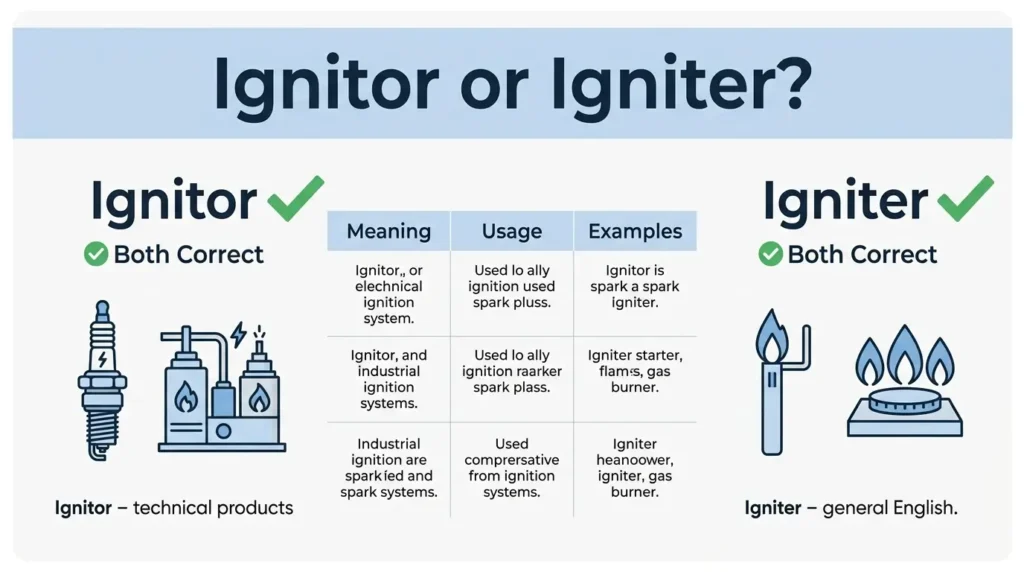
“Igniter” and “ignitor” are both correct spellings. “Igniter” is more common in general English, while “ignitor” appears more often in technical and engineering contexts.
People often search for “ignitor or igniter” because both spellings appear online, in manuals, and in product names. At first glance, the two words seem interchangeable. They sound the same, relate to fire or ignition, and are used in technical and everyday writing. This creates confusion for students, writers, engineers, and buyers looking for the correct spelling.
Here is the quick answer: both ignitor and igniter are correct English words. However, igniter is far more common in modern English, especially in general writing and product descriptions. Ignitor still appears in technical industries, brand names, and engineering documents.
The confusion exists because English allows different endings for some nouns. Words ending in “-er” and “-or” sometimes develop side by side over time. One version usually becomes more popular, while the other survives in specialized usage.
This article explains the difference clearly. You will learn which spelling is more common, where the words came from, how British and American English treat them, and which form you should use for different audiences. You will also see real examples, common mistakes, usage trends, and helpful comparison tables.
Ignitor or Igniter – Quick Answer
Both ignitor and igniter are correct.
✅ Igniter → more common in everyday English
✅ Ignitor → used mainly in technical or industrial contexts
Examples:
- The gas stove igniter stopped working.
- The engine ignitor needs replacement.
Simple rule:
General writing → use igniter
Technical or industry-specific writing → ignitor may appear
The Origin of Ignitor or Igniter
Both words come from the verb ignite, which means “to catch fire” or “to start burning.” The word ignite comes from the Latin word ignire, meaning “to set on fire.”
Over time, English formed nouns from ignite using two common endings:
- “-er” → igniter
- “-or” → ignitor
English often creates similar variations this way:
| -er Form | -or Form |
| adviser | advisor |
| adapter | adaptor |
| connecter | connector |
In many cases, one spelling becomes more popular. For ignite, igniter became the dominant everyday spelling, while ignitor remained common in technical fields like aerospace, automotive systems, and industrial equipment.
British English vs American English Spelling
Unlike many English words, there is no strict British vs American difference here.
| English Type | Preferred Form | Notes |
| American English | Igniter | More common overall |
| British English | Igniter | Also preferred |
| Technical Industry Usage | Ignitor | Still widely used |
Both countries understand both spellings, but igniter appears more often in dictionaries, product listings, and daily writing.
Which Spelling Should You Use?
The best spelling depends on your audience and purpose.
Use “Igniter” When:
- Writing blogs or articles
- Creating academic content
- Writing emails or reports
- Talking to a general audience
- Selling products online
Example:
- Replace the furnace igniter immediately.
Use “Ignitor” When:
- Following a manufacturer’s terminology
- Writing technical manuals
- Working in aerospace or engineering
- Referring to official product names
Example:
- The rocket ignitor activated successfully.
Audience-Based Advice
| Audience | Best Choice |
| US audience | Igniter |
| UK audience | Igniter |
| Global audience | Igniter |
| Engineering audience | Ignitor may fit |
For SEO and readability, igniter is usually the safer choice because it has higher search volume and broader recognition.
Common Mistakes with Ignitor or Igniter
People often assume one spelling is completely wrong. That is not true. The real issue is choosing the wrong version for the context.
Common Errors
❌ Saying ignitor is incorrect
✅ Both spellings are valid
❌ Using ignitor in casual writing unnecessarily
✅ Use igniter for general readers
❌ Mixing both spellings randomly in one article
✅ Stay consistent throughout the content
❌ Assuming British English uses ignitor
✅ British English also prefers igniter
Ignitor or Igniter in Everyday Examples
Emails
- The oven igniter needs repair.
- Our technician replaced the faulty ignitor.
News
- Engineers tested the rocket igniter successfully.
- The vehicle ignitor system failed during inspection.
Social Media
- My gas stove igniter finally works again.
- New jet ignitor technology improves efficiency.
Formal Writing
- The igniter creates the spark needed for combustion.
- Aircraft ignitor systems require regular maintenance.
Ignitor or Igniter – Google Trends & Usage Data
Search data shows that igniter is much more popular worldwide. It appears more often in:
- Appliance repair searches
- Product descriptions
- Educational content
- Online shopping results
Ignitor has lower search volume but remains important in technical industries. Aerospace companies, automotive manuals, and industrial engineering documents still use it regularly.
Countries with strong search interest include:
- United States
- Canada
- United Kingdom
- India
- Australia
Most users search this keyword because they want to know whether ignitor is a spelling mistake. In reality, both forms are accepted.
Comparison Table: Ignitor vs Igniter
| Word | Correct? | Common Usage | Notes |
| Igniter | ✅ Yes | Everyday English | Most common spelling |
| Ignitor | ✅ Yes | Technical fields | Engineering usage |
| Ignite | ✅ Yes | Verb form | Means “to start burning” |
| Ignition | ✅ Yes | Related noun | Refers to starting combustion |
FAQs About Ignitor or Igniter
1. Is ignitor a real word?
Yes. Ignitor is a correct English word used mainly in technical contexts.
2. Which spelling is more common?
Igniter is much more common in modern English.
3. Is ignitor wrong in American English?
No. It is accepted, especially in engineering and manufacturing.
4. Do British and American English differ here?
No major difference exists. Both usually prefer igniter.
5. Which spelling should I use for SEO?
Igniter is generally better because it has higher search volume.
6. Why do both spellings exist?
English allows both “-er” and “-or” noun endings for some words.
7. Should I use both spellings in one article?
No. Choose one spelling and stay consistent.
Conclusion
The confusion between ignitor or igniter comes from the flexible nature of English spelling. Both words are correct, both relate to ignition, and both appear in real-world usage. The difference is mainly about context and popularity.
Igniter is the standard choice for most people. It appears more often in general English, online searches, product descriptions, and educational writing. If you are writing for a broad audience, igniter is usually the best option.
Ignitor is not a mistake. It remains common in technical industries, engineering manuals, aerospace systems, and specialized equipment documentation. In those fields, the spelling may even be preferred.
There is no major British or American difference here. The key is consistency and audience awareness. Understanding this small spelling variation can make your writing clearer, more professional, and easier to understand.