

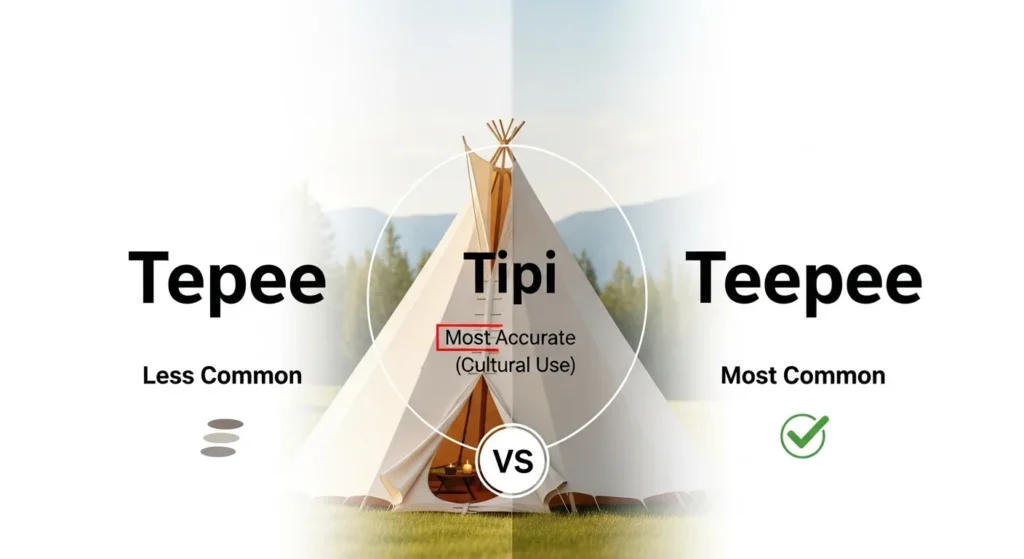
Both “tepee” and “teepee” are correct. “Tipi” is the most accurate modern form, while “teepee” is more common in general use.
Many people feel confused about “tepee or teepee.” Both spellings look right, and both are used online, in books, and in daily writing. This makes it hard to choose the correct one.
This confusion happens because the word comes from a Native American language. When it entered English, different spellings were created to match the sound. Over time, multiple versions became accepted.
Choosing the right spelling matters, especially in writing. It helps you stay clear, respectful, and consistent. Some forms are more modern, while others are more traditional.
In this article, you will learn the meaning, origin, and correct use of tepee and teepee. You will also see examples, common mistakes, and simple tips. By the end, you will know which spelling to use with confidence.
Tepee or Teepee – Quick Answer
- Tepee → Correct but less common
- Teepee → Correct and widely used
- Tipi → Most accurate modern spelling
Meaning:
A tepee / teepee / tipi is a cone-shaped tent used by Indigenous peoples of North America.
Examples:
- They built a teepee in the camp.
- The museum displayed a traditional tipi.
Rule: All are correct, but “teepee” is most common in everyday English.
The Origin of Tepee or Teepee
The word comes from the Lakota word thípi, meaning “a place to live.”
Over time:
- The sound was written in English as tipi
- Later, spellings like tepee and teepee appeared
Why different spellings exist:
- English tried to match the original sound
- No single standard spelling at first
- Cultural and regional influence
Today, tipi is often preferred in academic and cultural contexts.
British English vs American English Spelling
There is no strict rule between British and American English.
| English Type | Common Form | Example Sentence |
| British English | Teepee | The children saw a teepee. |
| American English | Teepee | They stayed in a teepee. |
| Cultural/Academic | Tipi | The exhibit showed a traditional tipi. |
All forms are understood worldwide.
Which Spelling Should You Use?
Your choice depends on context.
Use teepee when:
- Writing for general audiences
- Creating blogs or simple content
- Using modern everyday English
Use tipi when:
- Writing in academic or cultural context
- Referring to authentic Indigenous terms
- Showing respect to original language
Use tepee when:
- Following older or less common usage
Audience guidance:
- US audience → Teepee or Tipi
- UK audience → Teepee
- Global audience → Teepee (safe choice)
Consistency is important in writing.
Common Mistakes with Tepee or Teepee
Here are common errors:
| Mistake | Correction |
| Thinking only one is correct | All are correct |
| Mixing spellings in one text | Choose one and stay consistent |
| Ignoring cultural context | Use “tipi” when needed |
| Spelling randomly | Follow a clear style |
Incorrect:
- The teepee and tepee were different (mixed usage).
Correct:
- The teepee was large.
- The tipi was well built.
Use one form at a time.
Tepee or Teepee in Everyday Examples
Emails
- “We visited a teepee camp last weekend.”
News
- “The festival featured a traditional tipi.”
Social Media
- “This teepee setup looks amazing!”
Formal Writing
- “The tipi is an important cultural structure.”
Travel Blogs
- “Guests can stay in a teepee for a unique experience.”
These words appear in many contexts.
Tepee or Teepee – Usage Data
Why people search this keyword:
- Spelling confusion
- Cultural awareness
- Writing accuracy
Popular regions:
- United States
- Canada
- United Kingdom
- India and Pakistan
Usage contexts:
- Travel and camping
- Education and history
- Cultural discussions
“Teepee” is most common in general use. “Tipi” is common in academic and cultural writing.
Comparison Table (Keyword Variations)
| Word | Status | Usage Type | Notes |
| Teepee | Correct | General use | Most common |
| Tepee | Correct | Less common | Older variation |
| Tipi | Correct | Cultural/academic | Most accurate form |
FAQs
1. Is “teepee” correct?
Yes, it is correct and widely used.
2. Is “tepee” wrong?
No, it is correct but less common.
3. What is the most accurate spelling?
“Tipi” is the most accurate form.
4. Which spelling is most popular?
“Teepee” is most common in everyday English.
5. Is there a regional difference?
No strict difference between US and UK.
6. Should I use “tipi” in formal writing?
Yes, especially in cultural or academic contexts.
7. Can I use all forms in one article?
It is better to stay consistent with one spelling.
Conclusion
The difference between “tepee” and “teepee” is mainly about usage, not correctness. Both forms are accepted in English, and both refer to the same cone-shaped tent used by Indigenous peoples of North America.
Among the options, “teepee” is the most common in everyday writing. It is widely used in blogs, travel content, and general communication. “Tepee” is less common but still correct. On the other hand, “tipi” is the most accurate form and is often preferred in academic and cultural contexts.
Understanding these differences helps you choose the right word for your audience. It also improves clarity and shows respect for cultural terms.
A simple rule is to use “teepee” for general writing and “tipi” for formal or cultural topics. Whatever you choose, stay consistent throughout your text.
Clear and correct usage makes your writing stronger and more professional.