

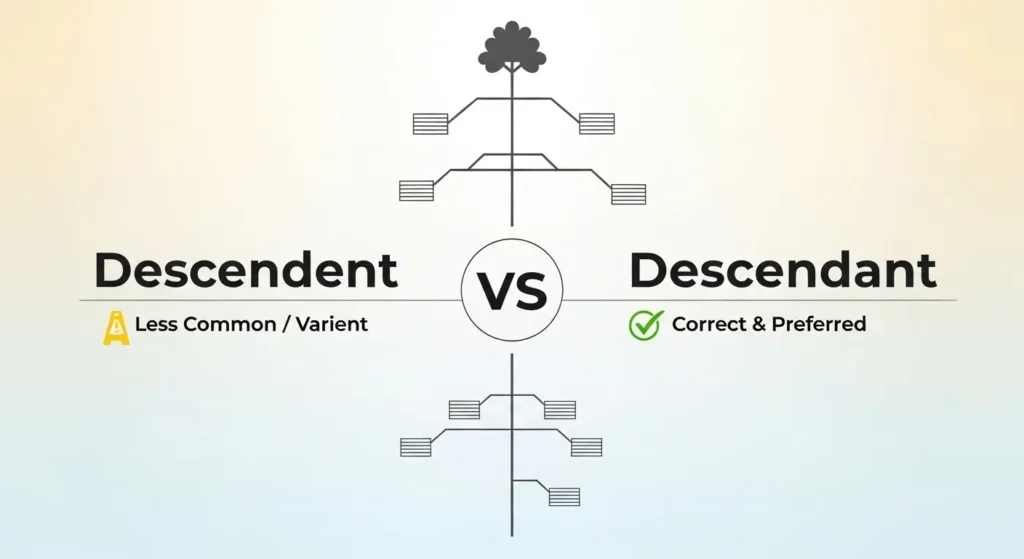
“Descendant” is the correct spelling for a person related to an ancestor. “Descendent” is rare and often considered a misspelling in modern usage.
Many people search for “descendent or descendant” because the words look almost the same. This makes it hard to know which one is correct.
Short answer: “Descendant” is correct. “Descendent” is usually wrong.
The confusion comes from spelling. Both words come from the same root, but only one is widely accepted today. When people write quickly or rely on sound, they may type “descendent” instead of “descendant.”
This small mistake can affect writing quality, especially in academic, historical, or family-related topics. Using the correct word shows clarity and attention to detail.
In this article, you will learn the meaning, origin, and correct usage of descendant. You will also see examples, common mistakes, and helpful tips. By the end, you will know exactly which spelling to use.
Descendent or Descendant – Quick Answer
- ❌ Descendent → Incorrect or very rare
- ✅ Descendant → Correct
Meaning:
A descendant is a person who comes from an ancestor.
Examples:
- She is a descendant of a famous king. ✅
- They are descendants of early settlers. ✅
Rule: Always use “descendant.”
The Origin of Descendent or Descendant
The word comes from Latin descendere, which means “to go down.”
Over time:
- It entered English through French
- It formed the word descendant
Why does “descendent” appear?
- It is influenced by the verb descend
- People assume the noun follows the same pattern
However, standard English uses descendant for people.
British English vs American English Spelling
There is no difference between British and American English.
| English Type | Correct Spelling | Example Sentence |
| British English | Descendant | He is a descendant of royalty. |
| American English | Descendant | She is a descendant of immigrants. |
| Incorrect Form | Descendent | ❌ Not standard usage |
One spelling works everywhere.
Which Spelling Should You Use?
Always use descendant.
Audience-based advice:
- US audience → Descendant
- UK/Commonwealth → Descendant
- Global audience → Descendant
Simple rule: Use the standard form in all writing.
Common Mistakes with Descendent or Descendant
Here are common errors:
| Mistake | Correction |
| Writing “descendent” | Use “descendant” |
| Mixing spellings | Stay consistent |
| Confusing with “descend” | Learn correct noun form |
| Using wrong form in essays | Proofread |
Incorrect:
- He is a descendent of the family. ❌
Correct:
- He is a descendant of the family. ✅
Tip: Remember “ant” at the end.
Descendant in Everyday Examples
Emails
- “She is a descendant of the founder.”
News
- “The descendants attended the ceremony.”
Social Media
- “Proud to be a descendant of strong people.”
Formal Writing
- “The study focused on royal descendants.”
Academic Work
- “Many descendants preserved the tradition.”
The word is common in history and family topics.
Descendent or Descendant – Usage Data
Why people search this keyword:
- Spelling confusion
- Similar word forms
- Writing accuracy
Popular regions:
- United States
- United Kingdom
- India
- Pakistan
Usage contexts:
- History and genealogy
- Academic writing
- Blogging
- Education
“Descendant” is widely used, while “descendent” appears mostly as a mistake.
Comparison Table (Keyword Variations)
| Word | Status | Meaning | Notes |
| Descendant | ✅ Correct | Family line person | Standard English |
| Descendent | ❌ Incorrect | Misspelling | Avoid using |
| Descendants | ✅ Correct | Plural form | Common usage |
FAQs
1. Is “descendent” correct?
No, it is generally considered incorrect in modern English.
2. What is the correct spelling?
The correct spelling is descendant.
3. What does “descendant” mean?
It means a person who comes from an ancestor.
4. Is there a UK vs US difference?
No, both use the same spelling.
5. Why do people confuse these words?
Because of similarity with the word “descend.”
6. Can I use “descendent” in formal writing?
No, it is better to avoid it.
7. How can I remember the spelling?
Think of “ant” at the end of descendant.
Conclusion
The difference between “descendent” and “descendant” is simple but important. The correct spelling is “descendant,” while “descendent” is usually a mistake.
This word is widely used in history, genealogy, and academic writing. It describes a person who comes from an ancestor. Because of its importance, using the correct spelling is essential.
There is no difference between British and American English, which makes learning easier. You only need to remember one correct form.
Spelling mistakes can affect clarity and professionalism. By using “descendant” correctly, you improve your writing and avoid confusion.
Final tip: Always remember the ending “ant”, and you will never get it wrong.