

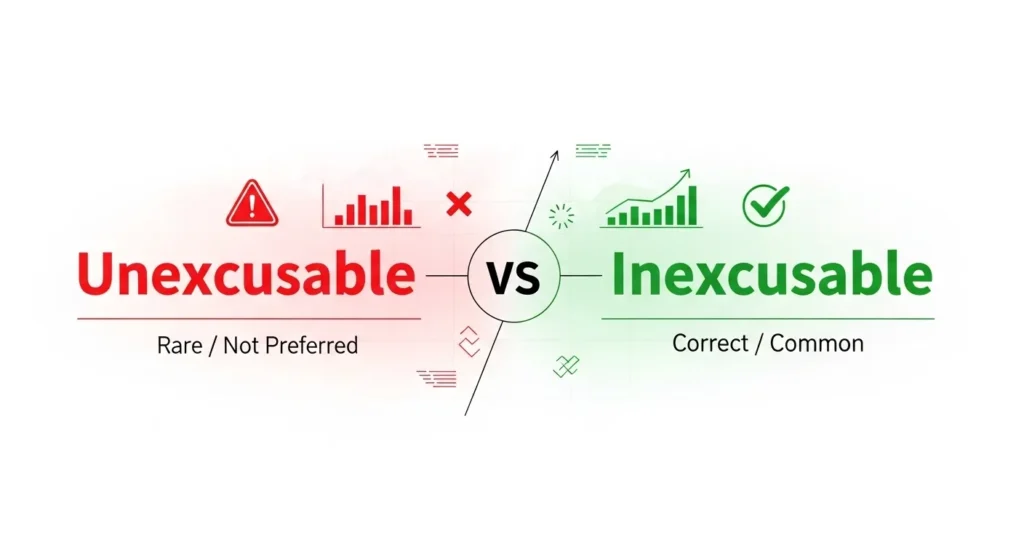
“Inexcusable” is the correct and standard spelling. It means something cannot be justified or forgiven. “Unexcusable” exists but is rare and less preferred in modern English.
Many people search for “unexcusable or inexcusable” because both words look correct and have similar meanings. This creates confusion, especially in writing.
You may see both forms in books, online content, or conversations, and wonder which one is right.
The confusion happens because English often uses prefixes like un- and in- to create negative meanings. Both can seem correct, but not all forms are equally accepted in modern usage.
Using the wrong word can make your writing sound awkward or outdated. That is why it is important to understand the difference clearly.
In this article, you will learn the correct usage, origin, and examples of both words. You will also see common mistakes and tips to avoid them. By the end, you will know exactly when to use “inexcusable” and why it is the better choice.
Unexcusable or Inexcusable – Quick Answer
- ✅ Inexcusable → Correct and widely used
- ⚠️ Unexcusable → Rare and less common
Meaning:
Both words mean something that cannot be forgiven or justified.
Examples:
- His behavior was inexcusable. ✅
- The delay was inexcusable. ✅
Rule: Always prefer “inexcusable” in modern English.
The Origin of Unexcusable or Inexcusable
The word comes from the verb “excuse.”
- Inexcusable = in- (not) + excuse + -able
- Unexcusable = un- (not) + excuse + -able
Both forms were used in older English. However:
- Inexcusable became more popular over time
- Unexcusable became rare and outdated
Why?
English often prefers one standard form, even if multiple are possible. In this case, “inexcusable” won common usage.
British English vs American English Spelling
There is no major difference between British and American English here.
| English Type | Preferred Word | Example Sentence |
| British English | Inexcusable | The mistake was inexcusable. |
| American English | Inexcusable | His actions were inexcusable. |
| Rare Form | Unexcusable | ⚠️ Very uncommon usage |
Both regions strongly prefer “inexcusable.”
Which Spelling Should You Use?
You should use inexcusable in almost all cases.
For different audiences:
- US audience → Use inexcusable
- UK/Commonwealth → Use inexcusable
- Global audience → Use inexcusable
Simple rule:
Choose the word that is clear, common, and widely accepted.
Avoid “unexcusable” unless you are reading or quoting old texts.
Common Mistakes with Unexcusable or Inexcusable
Here are common errors:
| Mistake | Correction |
| Using “unexcusable” in writing | Use “inexcusable” |
| Thinking both are equal | Prefer standard form |
| Mixing prefixes randomly | Learn common usage |
| Using rare forms in formal text | Stick to modern English |
Incorrect:
- His actions were unexcusable. ⚠️
Correct:
- His actions were inexcusable. ✅
Tip: If unsure, always choose inexcusable.
Unexcusable or Inexcusable in Everyday Examples
Emails
- “The delay is inexcusable.”
News
- “The error was called inexcusable by officials.”
Social Media
- “This behavior is totally inexcusable!”
Academic Writing
- “Such mistakes are inexcusable in research.”
Business Writing
- “Poor service is inexcusable.”
👉 “Inexcusable” works in all types of writing.
Unexcusable or Inexcusable – Google Trends & Usage Data
Why people search this keyword:
- Confusion between similar prefixes
- Need for correct grammar
- Writing improvement
Popular regions:
- United States
- United Kingdom
- India
- Pakistan
Usage contexts:
- Academic writing
- Professional communication
- Blogging and SEO
- Social media
👉 “Inexcusable” is searched and used far more than “unexcusable.”
Comparison Table (Keyword Variations)
| Word | Status | Usage Level | Notes |
| Inexcusable | ✅ Correct | Very common | Standard modern English |
| Unexcusable | ⚠️ Rare | Very uncommon | Outdated or less preferred |
| Excusable | ✅ Correct | Common | Means can be forgiven |
| Unexcused | ✅ Correct | Different meaning | Not officially excused |
FAQs
1. Is “unexcusable” wrong?
Not fully wrong, but it is rare and not preferred.
2. Which word is correct?
“Inexcusable” is the correct and standard word.
3. Why are there two forms?
Both use different prefixes (un- and in-), but only one became common.
4. Is “inexcusable” formal?
Yes, it is used in both formal and informal writing.
5. Can I use “unexcusable” in essays?
It is better to avoid it and use “inexcusable.”
6. Do UK and US English differ here?
No, both prefer “inexcusable.”
7. How can I remember the correct word?
Think: “inexcusable = standard and correct.”
Conclusion
The difference between “unexcusable” and “inexcusable” is simple once you understand usage. Both words have similar meanings, but only one is widely accepted in modern English. That word is “inexcusable.”
Over time, English has favored clarity and consistency. Even though both forms were once used, “inexcusable” became the standard. Today, it is used in professional writing, academic work, and everyday communication.
Using the correct word helps you write clearly and confidently. It also improves how others see your writing. Small choices like this can make a big difference, especially in formal contexts.
There is no need to worry about regional differences, as both British and American English use the same form. This makes your decision even easier.
Final tip: When in doubt, always choose “inexcusable.” It is clear, correct, and widely accepted.