

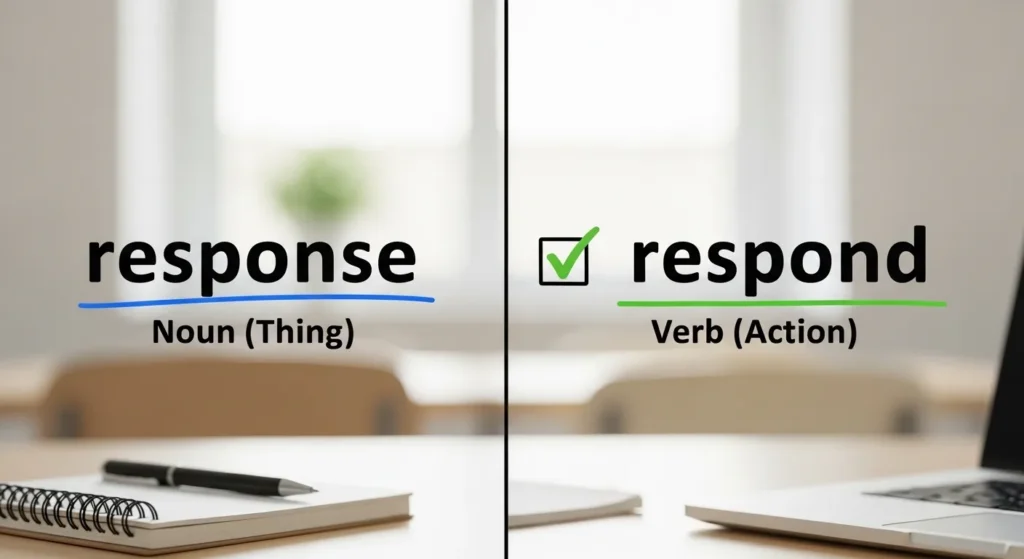
Short answer: “Respond” is a verb (action), and “response” is a noun (thing).
Many people search for “response or respond” because they get confused about when to use each word.
Both words come from the same root and have similar meanings, so it is easy to mix them up in writing. This mistake is very common in emails, essays, and professional communication.
This confusion often leads to incorrect sentences like “I will response” instead of “I will respond.” Small errors like this can affect clarity and make writing look unprofessional.
In this article, you will learn the simple difference between response and respond, their origin, correct usage, and real-life examples.
You will also see common mistakes and how to fix them. By the end, you will clearly understand when to use each word and improve your writing with confidence.
Response or Respond – Quick Answer
The difference is simple:
- Respond → Verb (an action)
- Response → Noun (a result or reply)
Examples:
- I will respond to your message soon. ✅
- Thank you for your quick response. ✅
Use respond when you talk about doing something.
Use response when you talk about the result.
The Origin of Response or Respond
Both words come from the Latin word respondere, which means “to answer” or “to reply.”
Over time:
- Respond stayed as a verb (action word)
- Response developed as a noun (the result of the action)
This pattern is common in English:
- decide → decision
- perform → performance
- respond → response
There is no spelling confusion. The difference is about grammar and function.
British English vs American English Spelling
There is no difference in spelling between British and American English.
| English Type | Verb Form | Noun Form | Example Sentence |
|---|---|---|---|
| British English | Respond | Response | She will respond quickly. |
| American English | Respond | Response | His response was helpful. |
| Incorrect Usage | Response (verb) | Respond (noun) | ❌ Wrong usage form |
Both forms are used the same way worldwide.
Which Spelling Should You Use?
You should use both, but in the correct way.
Use respond when:
- You describe an action
- You give instructions
- You talk about replying
Use response when:
- You describe a result
- You refer to a reply
- You write formally
Audience-based advice:
- US audience → Same rule
- UK/Commonwealth → Same rule
- Global audience → Focus on grammar
Always match the word to its role in the sentence.
Common Mistakes with Response or Respond
Here are common mistakes:
| Mistake | Correction |
|---|---|
| I will response soon | I will respond soon |
| Thank you for respond | Thank you for your response |
| He gave a quick respond | He gave a quick response |
| Please response quickly | Please respond quickly |
Incorrect:
- Please response to this email. ❌
Correct:
- Please respond to this email. ✅
Tip: If it shows action, use respond.
Response or Respond in Everyday Examples
Emails
- “I will respond within 24 hours.”
- “Thank you for your response.”
News
- “The government will respond to the issue.”
- “The public response was strong.”
Social Media
- “He did not respond to comments.”
- “The post got a huge response.”
Academic Writing
- “Participants were asked to respond.”
- “The response rate increased.”
Business Writing
- “We will respond quickly.”
- “Customer response improved.”
Both words are used daily in many contexts.
Response or Respond – Google Trends & Usage Data
Why people search this keyword:
- Grammar confusion
- Writing improvement
- Professional communication needs
Popular regions:
- United States
- United Kingdom
- India
- Pakistan
Usage contexts:
- Emails and office work
- Academic writing
- Blogging and SEO
- Social media communication
Many users want to avoid simple grammar mistakes.
Comparison Table (Keyword Variations)
| Word | Part of Speech | Meaning | Example |
|---|---|---|---|
| Respond | Verb | To reply or answer | I will respond soon. |
| Response | Noun | A reply or reaction | Her response was quick. |
| Responded | Verb (past) | Replied earlier | He responded yesterday. |
| Responding | Verb (present) | Replying now | She is responding now. |
FAQs
1. What is the main difference between response and respond?
“Respond” is a verb, while “response” is a noun.
2. Can I use “response” as a verb?
No, it is incorrect.
3. Which word is more formal?
“Response” is often more formal.
4. Is there a spelling difference in US and UK English?
No, both use the same spelling.
5. How can I remember the difference?
Think: respond = action, response = result.
6. Can both words be used in emails?
Yes, both are commonly used.
7. Is “respond” informal?
No, it works in both formal and informal writing.
Conclusion
The difference between “response” and “respond” is simple but very important. The key rule is easy to remember: respond is a verb (action), and response is a noun (result). Once you understand this, you can avoid common mistakes in writing.
Both words come from the same Latin root, but they serve different roles in a sentence. There is no difference between British and American English, so you only need to focus on correct usage. This makes learning even easier.
In everyday writing—emails, reports, social media, or academic work—using the correct word improves clarity and professionalism. Even small grammar errors can affect how your message is understood. That is why it is important to choose the right form.
A simple trick is to check your sentence. If you need an action, use respond. If you need a result or thing, use response. With practice, this choice becomes natural.
Final tip: Match the word to its function, and your writing will always be clear and correct.