

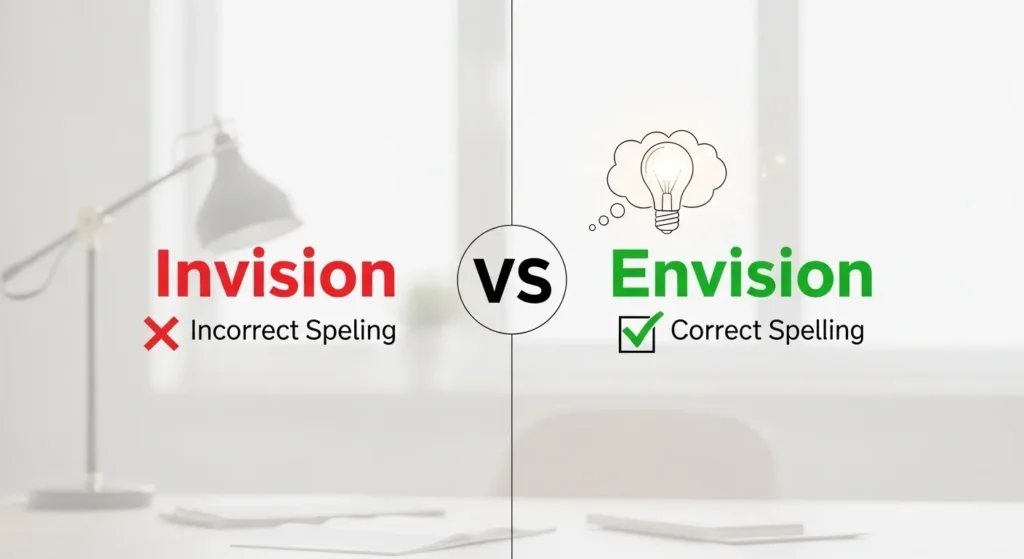
“Envision” is the correct spelling. It means to imagine or clearly picture something in your mind.
“Invision” is not a real English word and should only be used when referring to the brand name InVision.
Have you ever written a word and stopped for a second thinking, “Is this right?”
That is exactly what happens with “envision” and “invision.”
They sound the same when spoken. That is why many people confuse them. But in writing, only one of them is correct.
This mistake is very common in emails, blogs, school work, and even professional writing. Many people type “invision” without realizing it is wrong.
The confusion happens because English spelling does not always match pronunciation. Also, people often see the word “InVision” online as a company name, which makes the wrong spelling feel correct.
If you are a student, writer, or professional, using the correct spelling matters. Small mistakes can affect your credibility and clarity.
In this guide, you will learn:
- The correct spelling
- The real meaning
- Why the mistake happens
- How to avoid it forever
By the end, you will never confuse these words again.
Envision or Invision – Quick Answer
❌ Invision → Incorrect (except brand name)
✅ Envision → Correct
Meaning:
Envision means to imagine or picture something clearly in your mind.
Examples:
- I envision a better future.
- She envisions success in her career.
Rule: Always use “envision” in writing.
Understanding the Confusion: Why People Mix Them Up
This confusion is not random. There are clear reasons behind it.
1. Same pronunciation
Both words sound almost identical when spoken.
2. Brain processes sound faster than spelling
We write what we hear → leads to “invision”
3. Brand influence
Many people see InVision (software company) online
This makes the spelling feel “normal”
4. Prefix confusion
People mix up:
- en- (correct)
- in- (incorrect here)
The Origin of Envision or Invision
The word envision comes from:
- en- → “to make” or “to put into”
- vision → “to see”
So, it means:
“to see something in your mind”
History
- First used in the 1600s
- Derived from French word “envisager”
- Used in literature, business, and psychology
Why “invision” exists
- Mishearing the word
- Fast typing mistakes
- Influence of brand name
The correct form has always been envision.
British English vs American English Spelling
There is no difference.
| English Type | Correct Spelling | Example |
| British English | Envision | She can envision success. |
| American English | Envision | He can envision growth. |
| Incorrect Form | Invision | ❌ Not correct |
However, in British English, you may also see:
- Envisage (similar meaning)
Which Spelling Should You Use?
Always use envision.
For all audiences:
- US → Envision
- UK → Envision
- Global → Envision
Exception:
Use InVision only when talking about the company.
Example:
- We designed the prototype in InVision.
Common Mistakes with Envision or Invision
| Mistake | Correction |
| Writing “invision” | Use “envision” |
| Copying brand spelling | Use correct word |
| Spelling by sound | Learn structure |
| Not proofreading | Always check |
Incorrect:
- I invision a new idea. ❌
Correct:
- I envision a new idea. ✅
Memory Tip:
Think → en + vision
Envision or Invision in Everyday Examples
Emails
“We envision strong growth next year.”
News
“Experts envision major economic changes.”
Social Media
“I envision a better life.”
Formal Writing
“The report envisions a new strategy.”
Business Writing
“The company envisions expansion.”
Envision vs Similar Words
| Word | Meaning Difference |
| Imagine | General thinking |
| Visualize | Creating mental image |
| Foresee | Predict future |
| Envision | Clear and purposeful imagining |
Key idea:
Envision = imagining with purpose
Envision or Invision – Usage Data
Why people search this:
- Spelling confusion
- Same pronunciation
- Writing improvement
Popular regions:
- USA
- UK
- India
- Pakistan
Real usage:
- “Envision” → used in blogs, books, business
- “Invision” → appears as mistake or brand
Comparison Table (Keyword Variations)
| Word | Status | Meaning | Notes |
| Envision | ✅ Correct | Imagine clearly | Standard |
| Invision | ❌ Incorrect | Misspelling | Avoid |
| InVision | ✅ Proper noun | Company name | Brand use |
| Envisioned | ✅ Correct | Past form | Common |
FAQs
1. Is “invision” a real word?
No, it is not standard English.
2. What is the correct spelling?
The correct spelling is envision.
3. Can I use “InVision”?
Yes, only for the company name.
4. Is there a UK vs US difference?
No, both use envision.
5. What does envision mean?
To imagine or picture clearly.
6. Why is this mistake common?
Because of pronunciation and brand influence.
7. Is “envisage” the same?
Yes, but more common in British English.
Conclusion
The confusion between “envision” and “invision” is very common, but easy to fix. The correct spelling is always “envision.”
“Invision” is not a real English word. It only exists as a brand name, which is why many people get confused.
This mistake happens because both words sound the same. Also, seeing “InVision” online makes the incorrect spelling feel correct.
There is no difference between British and American English, so you only need to remember one standard form.
Using the correct spelling improves your writing, builds trust, and makes your content look professional.
A simple trick is to remember “en + vision.”
Once you understand this, you will never make this mistake again.