

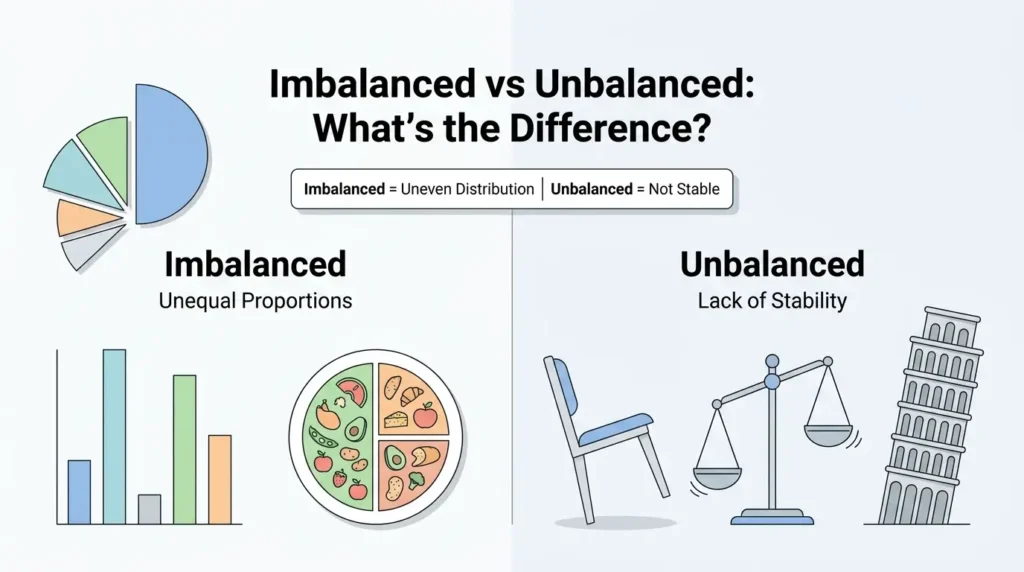
Imbalanced and unbalanced are both correct English words, but they are not always interchangeable. Imbalanced is often used for unequal proportions, systems, finances, or health conditions, while unbalanced usually describes a lack of stability, symmetry, or emotional control. Choose the word based on the context rather than spelling preference.
Have you ever wondered whether you should write imbalanced or unbalanced? At first glance, the two words seem almost identical. Both suggest that something is not in proper balance. However, they are used in different situations, and choosing the wrong one can make your writing sound awkward or inaccurate.
This confusion is common among students, writers, professionals, and English learners. You may see both words in news articles, health discussions, financial reports, fitness guides, and everyday conversations. Because they share a similar meaning, many people assume they are interchangeable. In reality, context matters.
Understanding the difference between imbalanced and unbalanced can help you communicate more clearly. Whether you are writing an academic paper, a business report, or a social media post, using the correct word improves accuracy and professionalism.
This guide explains the meanings, origins, usage differences, common mistakes, real-world examples, and practical advice for choosing the right word. By the end, you will know exactly when to use imbalanced and when unbalanced is the better choice.
Imbalanced or Unbalanced – Quick Answer
Both words are correct, but they have different uses.
| Word | Meaning | Example |
| Imbalanced | Unequal, disproportionate, or not properly distributed | The diet is imbalanced. |
| Unbalanced | Not stable, not level, or emotionally unstable | The chair is unbalanced. |
Examples:
- The company’s budget is imbalanced.
- The table is unbalanced.
- An imbalanced diet can affect health.
- The ladder feels unbalanced.
The simplest rule is:
- Use imbalanced for unequal proportions or distribution.
- Use unbalanced for instability, unevenness, or lack of control.
The Origin of Imbalanced or Unbalanced
Both words come from the noun balance.
The word balance entered English through Old French and ultimately comes from the Latin word bilanx, meaning “having two scales.”
Imbalanced
The prefix im- means “not.” Therefore, imbalanced literally means “not balanced.” It became common in scientific, medical, economic, and technical writing.
Unbalanced
The prefix un- also means “not.” However, unbalanced developed a broader everyday meaning. It is often used for physical instability, emotional instability, and uneven structures.
Because both prefixes mean “not,” the meanings overlap in some situations. That overlap is why writers often confuse them.
British English vs American English Spelling
There is no spelling difference between British and American English.
| Meaning | British English | American English |
| Unequal proportions | Imbalanced | Imbalanced |
| Lack of stability | Unbalanced | Unbalanced |
Both countries use the same spellings and meanings.
Unlike words such as colour/color or centre/center, there is no regional variation here.
Which Spelling Should You Use?
The choice depends entirely on context.
Use Imbalanced When:
- Talking about diets
- Discussing finances
- Describing statistics
- Referring to systems or distributions
- Explaining unequal proportions
Examples:
- An imbalanced workload causes stress.
- The economy became imbalanced after the crisis.
- The team has an imbalanced mix of skills.
Use Unbalanced When:
- Describing physical instability
- Talking about emotions
- Discussing uneven objects
- Referring to poor coordination
Examples:
- The shelf looks unbalanced.
- He became emotionally unbalanced.
- The bicycle feels unbalanced.
Audience-Based Advice
| Audience | Recommended Usage |
| US audience | Context-based choice |
| UK audience | Context-based choice |
| Global audience | Context-based choice |
The rule is universal.
Common Mistakes with Imbalanced or Unbalanced
Mistake 1: Using Unbalanced for Unequal Distribution
❌ The company has an unbalanced budget.
✔ The company has an imbalanced budget.
Mistake 2: Using Imbalanced for Physical Stability
❌ The chair feels imbalanced.
✔ The chair feels unbalanced.
Mistake 3: Assuming Both Words Always Mean the Same Thing
❌ They are completely interchangeable.
✔ They overlap sometimes, but context determines the better choice.
Mistake 4: Using Imbalanced for Emotional Instability
❌ He appeared mentally imbalanced.
✔ He appeared emotionally unbalanced.
Imbalanced or Unbalanced in Everyday Examples
Emails
The project has an imbalanced allocation of resources.
The desk seems unbalanced after being moved.
News
Experts warn that an imbalanced economy may slow growth.
The vehicle became unbalanced during the accident.
Social Media
An imbalanced lifestyle can lead to burnout.
That tower looks completely unbalanced.
Formal Writing
Researchers identified an imbalanced distribution of income.
The structure became unbalanced after modifications.
Imbalanced or Unbalanced – Google Trends & Usage Data
Search interest for imbalanced or unbalanced remains steady because the words appear in many fields.
Imbalanced Searches Often Come From:
- Health and nutrition topics
- Economic reports
- Data analysis
- Business management
Unbalanced Searches Often Come From:
- Mental health discussions
- Engineering topics
- Sports and fitness
- Everyday communication
Countries with strong search interest include:
- United States
- United Kingdom
- Canada
- Australia
- India
Most users search this comparison to improve writing accuracy or understand subtle differences in meaning.
Comparison Table: Imbalanced vs Unbalanced
| Feature | Imbalanced | Unbalanced |
| Correct English word | Yes | Yes |
| Refers to unequal proportions | Yes | Sometimes |
| Refers to physical instability | Rarely | Yes |
| Used in health discussions | Common | Less common |
| Used in finance | Common | Rare |
| Used for emotions | Rare | Common |
| Used in technical writing | Common | Moderate |
| Used in everyday speech | Moderate | Very common |
FAQs
Is imbalanced a real word?
Yes. It is a standard English word used to describe unequal proportions or distribution.
Is unbalanced a real word?
Yes. It describes instability, unevenness, or emotional imbalance.
Which word is more common?
Unbalanced is generally more common in everyday speech.
Can imbalanced and unbalanced mean the same thing?
Sometimes, but context usually makes one choice more natural.
Is an imbalanced diet correct?
Yes. This is one of the most common uses of imbalanced.
Is an unbalanced chair correct?
Yes. Unbalanced is the correct choice for physical instability.
Do British and American English use different spellings?
No. Both use the same spellings.
Conclusion
The difference between imbalanced and unbalanced is subtle but important. Both words describe a lack of balance, yet they are commonly used in different contexts. Imbalanced usually refers to unequal proportions, distributions, systems, finances, or health-related situations. Unbalanced, on the other hand, is often used for physical instability, emotional instability, or objects that are not properly level.
There is no spelling difference between British and American English, so your choice should depend entirely on meaning. If you are discussing an uneven diet, a disproportionate budget, or an unequal workload, imbalanced is usually the better word. If you are describing a shaky chair, an unstable structure, or emotional instability, unbalanced is typically the correct option.
Understanding this distinction helps improve clarity, professionalism, and accuracy in writing. While the two words overlap occasionally, choosing the one that best matches your context will make your message clearer and easier for readers to understand.