

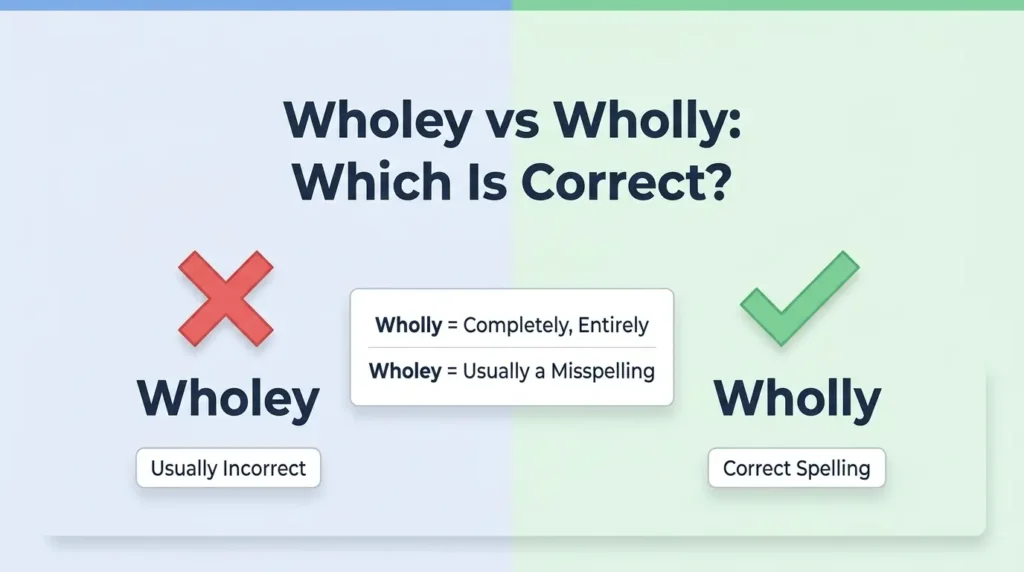
“Wholly” is the correct and standard English spelling when you mean entirely, completely, or fully. “Wholey” is usually considered a misspelling in modern English, except when it appears as part of a proper name or brand.
English spelling can be tricky, especially when two words look almost identical. One common example is wholey or wholly. Many writers, students, and English learners search for this phrase because they are unsure which spelling is correct.
The confusion happens because both words appear possible at first glance. The word whole ends with an “e,” so many people naturally assume the adverb should become wholey. However, English follows a different pattern in this case.
Adding to the confusion, some businesses and family names use Wholey as a surname or brand name. This can make people think both spellings are acceptable in everyday writing.
In reality, standard English recognizes wholly as the correct adverb meaning entirely, completely, or fully. Understanding this distinction helps you avoid common writing mistakes and communicate more clearly.
This guide explains the difference, origin, usage rules, examples, common mistakes, and practical advice for choosing the correct spelling every time.
Wholey or Wholly – Quick Answer
The answer is simple:
Wholly = completely, entirely, fully
Wholey = generally a misspelling or a proper name
Examples
✅ I wholly support the proposal.
✅ The project was wholly successful.
❌ I wholey support the proposal.
❌ The company was wholey prepared.
If you mean “completely,” always use wholly.
The Origin of Wholey or Wholly
The word wholly comes from the Old English word hal, meaning entire, complete, or healthy. Over time, English developed the adverb form wholly to express the idea of something being complete or total.
The spelling may look unusual because the final “e” from whole is dropped and replaced with the suffix “-ly.” English spelling evolved this way centuries ago, and the form became standardized.
The spelling wholey never became accepted in standard English grammar. Today, it appears mainly in personal names, family surnames, and business names rather than as a dictionary word.
Because of its connection to the word whole, many writers mistakenly create the spelling wholey, but dictionaries recognize wholly as the correct form.
British English vs American English Spelling
Unlike many English spelling debates, there is no difference between British and American English.
| Meaning | British English | American English |
| Completely or entirely | Wholly | Wholly |
| Alternative spelling | Not accepted | Not accepted |
Both language varieties use wholly.
Neither British nor American English accepts wholey as a standard spelling.
Which Spelling Should You Use?
The rule is straightforward.
US Audience
Use wholly.
UK Audience
Use wholly.
Commonwealth Countries
Use wholly.
Global Audience
Use wholly.
There is no regional variation.
Simple Rule
If you mean:
- Completely
- Entirely
- Fully
- Totally
Use wholly.
Never use wholey unless it is part of a person’s name, company name, or brand.
Common Mistakes with Wholey or Wholly
Many writers make mistakes because they assume the adverb form of whole should keep the letter e. Here are the most common errors:
Mistake 1: Adding an Extra “e”
❌ The report was wholey accurate.
✅ The report was wholly accurate.
Mistake 2: Assuming Both Spellings Are Correct
❌ Wholey and wholly mean the same thing.
✅ Only wholly is correct in standard English.
Mistake 3: Copying Brand Names
❌ Using wholey because you saw it in a company name.
✅ Use wholly unless referring to a specific name or trademark.
Memory Tip
Think of wholly as:
whole + ly = wholly
The spelling changes, but the meaning stays the same.
Wholey or Wholly in Everyday Examples
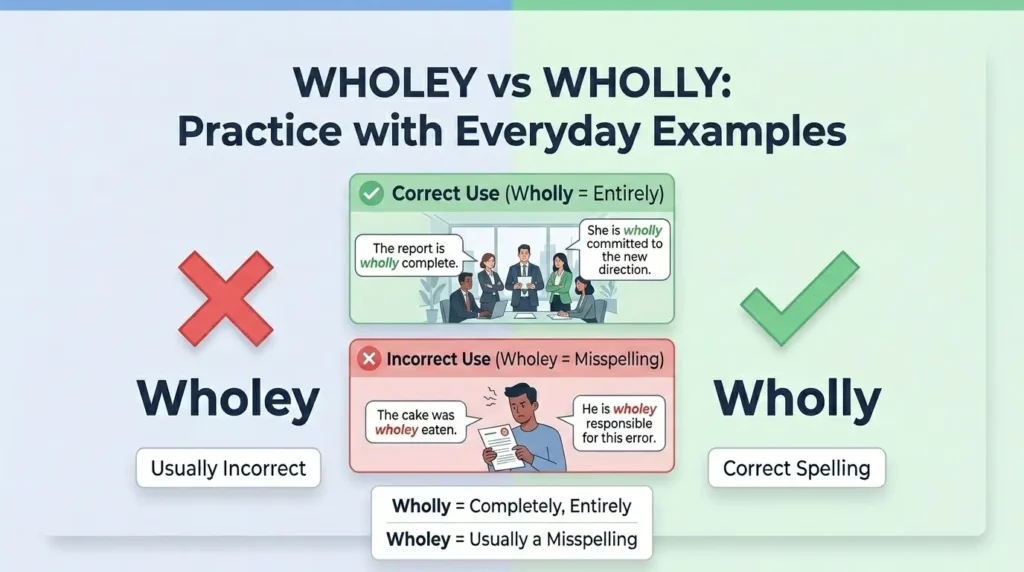
Emails
I wholly agree with your recommendation.
News
The government is not wholly responsible for the outcome.
Social Media
I am wholly committed to my goals this year.
Formal Writing
The results were wholly consistent with previous studies.
Business Writing
The company is wholly owned by its parent organization.
Academic Writing
The evidence does not wholly support the theory.
Wholey or Wholly – Google Trends & Usage Data
Searches for wholey or wholly remain steady because many people are unsure about the correct spelling. Students, writers, bloggers, and professionals often search this phrase when editing documents or creating content.
Online usage data shows that wholly appears millions of times in books, articles, academic papers, and business documents. The spelling wholey appears far less often and is usually connected to names, businesses, or spelling-related searches.
Countries with strong search interest include:
- United States
- United Kingdom
- Canada
- Australia
- India
Most searches happen because users want to verify the correct spelling before publishing content.
Wholey vs Wholly Comparison Table
| Word | Correct? | Meaning | Usage |
| Wholly | Yes | Completely, entirely, fully | Standard English |
| Wholey | No (usually) | Not accepted as standard English | Names and brands only |
FAQs About Wholey or Wholly
1. Is wholey a real word?
Not in standard English. It is mainly found in surnames, business names, and trademarks.
2. Is wholly the correct spelling?
Yes. Wholly is the accepted spelling when you mean completely or entirely.
3. Why isn’t it spelled wholey?
English developed the adverb form as wholly, dropping the final “e” from whole.
4. Do British and American English spell it differently?
No. Both use wholly.
5. Can spellcheck catch wholey?
Usually yes, but not always if the word appears as a proper name.
6. What part of speech is wholly?
Wholly is an adverb.
7. How can I remember the correct spelling?
Remember that dictionaries accept wholly and reject wholey for normal writing.
Conclusion
The choice between wholey or wholly is actually very simple once you understand the rule. Wholly is the correct spelling in standard English and means completely, entirely, or fully. It is used in everyday conversation, academic writing, business communication, news articles, and professional documents.
The spelling wholey is generally considered incorrect for normal writing. Although it may appear in company names, trademarks, or family surnames, it should not be used when you want to express the idea of something being complete or total.
There is no difference between British English and American English on this issue. Both language varieties use wholly as the accepted form. Writers who use wholey often do so because they assume the word should follow the spelling of whole, but English history established a different standard.
If you remember one simple rule, remember this: whenever you mean completely, fully, or entirely, choose wholly. Doing so will keep your writing accurate, professional, and easy to understand.