

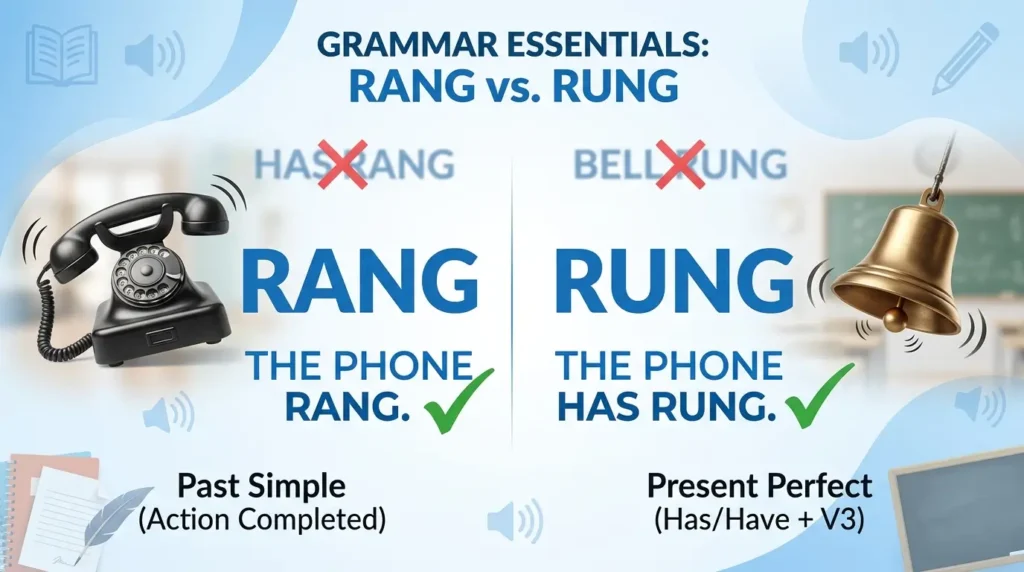
“Rang” and “rung” are both correct, but they are used differently. “Rang” is the simple past tense of “ring,” while “rung” is the past participle. You say, “The phone rang,” but “The phone has rung.” Many people confuse these forms because both relate to the verb “ring.”
English verbs can be confusing, especially when one word changes form depending on the sentence. A common example is “rang or rung.”
Many people are unsure which word to use because both come from the verb “ring.” You may have seen sentences like “The bell rung” or “The bell rang” and wondered which one is correct.
The confusion happens because English uses different verb forms for past tense and past participles. Native speakers also make mistakes with these words in casual writing and social media posts. Since both words sound similar and appear in everyday conversation, the error is very common.
Using the correct form matters in school writing, professional emails, blogs, and daily communication. A small grammar mistake can make writing look less polished. The good news is that the rule is simple once you understand it.
In this guide, you will learn the difference between rang and rung, their meanings, origins, grammar rules, examples, common mistakes, and the correct usage in British and American English.
Rang or Rung – Quick Answer
Both words are correct, but they are used differently.
| Word | Grammar Role | Example |
| Rang | Simple past tense | The alarm rang loudly. |
| Rung | Past participle | The alarm has rung twice. |
Quick rule:
- Use “rang” without helping verbs.
- Use “rung” with helping verbs like has, have, or had.
Correct examples:
- She rang the doorbell.
- The bell has rung already.
Incorrect examples:
- The bell rung loudly.
- She has rang me twice.
The Origin of Rang or Rung
The words “rang” and “rung” come from the Old English verb “ringan,” which meant “to sound” or “to make a ringing noise.”
English verbs changed over time, and “ring” became an irregular verb. Instead of adding “-ed” like regular verbs, it changed internally:
| Base Verb | Past Tense | Past Participle |
| Ring | Rang | Rung |
This pattern is similar to:
| Base Verb | Past Tense | Past Participle |
| Sing | Sang | Sung |
| Drink | Drank | Drunk |
| Begin | Began | Begun |
That is why people often confuse rang and rung. English irregular verbs do not always follow simple spelling rules.
British English vs American English Spelling
There is no spelling difference between British and American English for rang and rung.
Both English types use the same grammar rules.
| English Type | Past Tense | Past Participle |
| British English | Rang | Rung |
| American English | Rang | Rung |
Examples in both styles:
- The church bells rang at noon.
- The phone has rung several times.
The grammar remains identical worldwide.
Which Spelling Should You Use?
Your choice depends on sentence structure, not location.
Use “rang” when describing a completed action in the past.
Examples:
- The teacher rang the bell.
- My phone rang during dinner.
Use “rung” when using helping verbs like:
- has
- have
- had
Examples:
- The bell has rung.
- She had rung the wrong number.
Audience-based advice:
| Audience | Correct Usage |
| US audience | Rang / Rung |
| UK audience | Rang / Rung |
| Academic writing | Use correct verb form |
| Global audience | Standard grammar rules |
Common Mistakes with Rang or Rung
Many people mix the two forms incorrectly.
Here are the most common mistakes:
| Incorrect | Correct |
| The bell rung loudly. | The bell rang loudly. |
| She has rang me already. | She has rung me already. |
| I rung the alarm. | I rang the alarm. |
| They had rang the bell. | They had rung the bell. |
Simple memory trick:
- Rang = simple past
- Rung = used with has/have/had
Think of similar patterns:
- Sing → Sang → Sung
- Ring → Rang → Rung
Rang or Rung in Everyday Examples
Emails
- My phone rang during the meeting.
- The support line has rung nonstop today.
News Headlines
- Alarm bells rang across the city.
- Emergency phones have rung repeatedly.
Social Media
- My doorbell rang at midnight.
- My phone has rung five times already.
Formal Writing
- The bell rang at exactly 9 a.m.
- The notification has rung several times.
School Writing
- The school bell rang early.
- The bell had rung before we arrived.
Rang or Rung – Google Trends & Usage Data
Search data shows that many users search for “rang or rung” because of grammar confusion.
Why people search this keyword:
- Confusion with irregular verbs
- School grammar questions
- Writing improvement
- Spoken English mistakes
Popular countries searching this term:
- United States
- United Kingdom
- India
- Pakistan
- Canada
Common search queries include:
- Is it rang or rung?
- Has rung or has rang?
- The bell rang or rung?
- Difference between rang and rung
“Rang” appears more often in casual speech because it is simple past tense. “Rung” appears frequently in formal grammar discussions and written English.
Comparison Table: Rang vs Rung
| Feature | Rang | Rung |
| Correct word | Yes | Yes |
| Verb type | Past tense | Past participle |
| Needs helping verb | No | Yes |
| Example | The bell rang. | The bell has rung. |
| Common mistake | Used with “has” | Used without helping verb |
| Formal English | Correct | Correct |
Grammar Rule Made Simple
Here is the easiest way to remember it:
Use Rang
When no helping verb appears.
Examples:
- The phone rang.
- Someone rang the bell.
Use Rung
When the sentence includes:
- has
- have
- had
Examples:
- The phone has rung twice.
- Someone had rung the alarm.
Similar Verb Patterns
English has many irregular verbs that follow the same pattern.
| Base Verb | Past Tense | Past Participle |
| Ring | Rang | Rung |
| Sing | Sang | Sung |
| Drink | Drank | Drunk |
| Swim | Swam | Swum |
| Begin | Began | Begun |
Learning these patterns helps improve grammar quickly.
Quick Practice: Rang or Rung
Choose the correct word.
- The bell _____ loudly.
Answer: rang
- Someone has _____ the doorbell.
Answer: rung
- My phone _____ during class.
Answer: rang
- The alarm had _____ all night.
Answer: rung
FAQs
1. Is “rang” correct?
Yes. “Rang” is the simple past tense of “ring.”
Example:
- The phone rang loudly.
2. Is “rung” correct?
Yes. “Rung” is the past participle of “ring.”
Example:
- The phone has rung twice.
3. Which is correct: “has rang” or “has rung”?
“Has rung” is correct.
Incorrect:
- She has rang me.
Correct:
- She has rung me.
4. Why do people confuse rang and rung?
Because both words come from the same verb and sound similar.
5. Is there a British vs American difference?
No. Both English types use the same forms.
6. Can I say “the bell rung”?
No. The correct sentence is:
- The bell rang.
7. How can I remember the rule?
Use:
- Rang alone
- Rung with has/have/had
Conclusion
The confusion between rang or rung is very common, but the grammar rule is actually simple. Both words are correct because they come from the verb “ring,” but they serve different purposes in a sentence.
“Rang” is the simple past tense. It describes an action that already happened. “Rung” is the past participle and must be used with helping verbs like has, have, or had.
Many English learners and even native speakers mix them up because irregular verbs do not follow normal grammar patterns. However, once you remember the structure, the mistake becomes easy to avoid.
A useful trick is to compare it with other irregular verbs like sing, sang, sung. The same pattern applies to ring, rang, rung.
Using the correct form improves your grammar, writing clarity, and professional communication. Whether you are writing emails, essays, blog posts, or social media captions, choosing the right word helps your writing sound more natural and correct.
The next time you hesitate between rang and rung, remember this simple rule:
“Rang” stands alone. “Rung” works with helping verbs.