

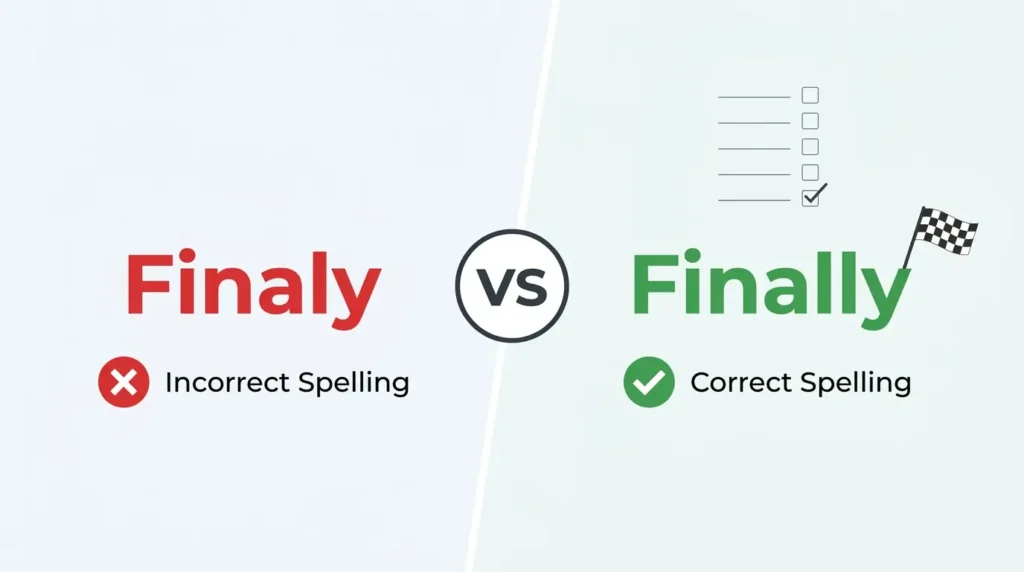
“Finally” is the correct spelling. It means at last or after a long time. “Finaly” is a common misspelling and should be avoided.
Many people get confused between “finally” and “finaly.” Both words look almost the same, and when spoken, they sound very similar. Because of this, it is easy to miss one letter and write the wrong form.
This mistake happens because English spelling rules are not always simple. When we add endings like “-ly” to words, sometimes letters change or double. In this case, the base word “final” becomes “finally,” and the letter “l” stays doubled.
People often type quickly or rely on how a word sounds, which leads to errors like “finaly.” This is very common in emails, social media, and even student writing.
Using the correct spelling is important. It makes your writing clear and professional. Even a small spelling mistake can affect how others understand your message.
In this article, you will learn the meaning, origin, and correct usage of finally. You will also see examples, common mistakes, and simple tips. By the end, you will be able to use this word correctly and confidently in any situation.
Finally or Finaly – Quick Answer
- ❌ Finaly → Incorrect
- ✅ Finally → Correct
Meaning:
Finally means “at last,” “in the end,” or “after a long time.”
Examples:
- We finally reached home after a long trip.
- She finally finished her homework.
- They finally solved the problem.
Rule: Always use “finally.”
The Origin of Finally or Finaly
The word finally comes from two parts:
- Base word final (meaning “last” or “end”)
- Suffix -ly (used to form adverbs)
When combined:
- Final + ly → Finally
This follows a common pattern in English where adjectives turn into adverbs by adding “-ly.”
Why do people write “finaly”?
- They drop one “l” by mistake
- They spell based on sound
- They type quickly without checking
- They do not know the rule of keeping both “l” letters
The correct form has always been finally, and it has been used in English for many years.
British English vs American English Spelling
There is no difference between British and American English for this word.
| English Type | Correct Form | Example Sentence |
|---|---|---|
| British English | Finally | He finally arrived. |
| American English | Finally | She finally understood. |
| Incorrect Form | Finaly | Not correct anywhere |
Unlike words like “color/colour,” this word has only one correct spelling worldwide.
Which Spelling Should You Use?
Always use finally.
For all audiences:
- US audience → Finally
- UK audience → Finally
- Global audience → Finally
There is no alternative spelling, so the choice is simple.
If you want clear and correct writing, always stick with finally.
Common Mistakes with Finally or Finaly
Here are the most common mistakes people make:
| Mistake | Correction |
|---|---|
| Writing “finaly” | Use “finally” |
| Forgetting double “l” | Remember “ll” |
| Typing too fast | Check your spelling |
| Spelling by sound | Learn the rule |
Incorrect examples:
- I finaly completed the work.
- We finaly reached the station.
Correct examples:
- I finally completed the work.
- We finally reached the station.
Simple tip:
Think of “final” + “ly” = finally
Finally in Everyday Examples
Emails
- “I have finally completed the report.”
- “We finally received your message.”
News
- “The team finally won the championship.”
- “The project was finally approved.”
Social Media
- “Finally done with exams!”
- “I finally got my dream job!”
Formal Writing
- “The results were finally published.”
- “The agreement was finally signed.”
Daily Conversation
- “We finally met after many years.”
- “She finally told the truth.”
The word finally is very common in both spoken and written English.
Finally or Finaly – Usage Data
Why people search this keyword:
- Confusion in spelling
- Missing one letter
- Learning correct English
- Improving writing skills
Popular regions:
- United States
- United Kingdom
- India
- Pakistan
Usage contexts:
- Emails and messages
- School and academic writing
- Social media posts
- Business communication
“Finally” is widely used in all types of writing. “Finaly” appears only as a mistake and is not accepted in standard English.
Comparison Table (Keyword Variations)
| Word | Status | Meaning | Notes |
|---|---|---|---|
| Finally | Correct | At last | Standard English |
| Finaly | Incorrect | Misspelling | Avoid using |
| Final | Base word | Last | Root form |
| Finally’s | Incorrect | Wrong form | Not needed |
FAQs
1. Is “finaly” correct?
No, it is a misspelling and should not be used.
2. What is the correct spelling?
The correct spelling is finally.
3. What does “finally” mean?
It means at last or after a long time.
4. Is there any regional difference?
No, both US and UK use the same spelling.
5. Why is “finally” spelled with double “l”?
Because it comes from “final” + “ly,” and the base word keeps both “l” letters.
6. Is “finally” formal or informal?
It can be used in both formal and informal writing.
7. How can I remember the spelling?
Think of “final” and simply add “ly.”
Conclusion
The confusion between “finally” and “finaly” is very common, but it is easy to fix once you understand the rule. The correct spelling is always “finally.” The shorter form “finaly” is incorrect and should not be used in proper writing.
This mistake often happens because people drop one letter while typing or try to spell the word based on how it sounds. However, the correct form comes from the base word “final” combined with “-ly,” which keeps both “l” letters.
There is no difference between British and American English, which makes this word easier to learn. No matter where you are writing, the correct form remains the same.
Using the correct spelling improves your writing and helps you communicate clearly. It also shows that you pay attention to detail, which is very important in professional and academic work.
A simple trick is to remember the full structure: final + ly = finally. Once you learn this, you will never make this mistake again.
Clear spelling leads to clear communication, and that makes your writing stronger and more effective.