

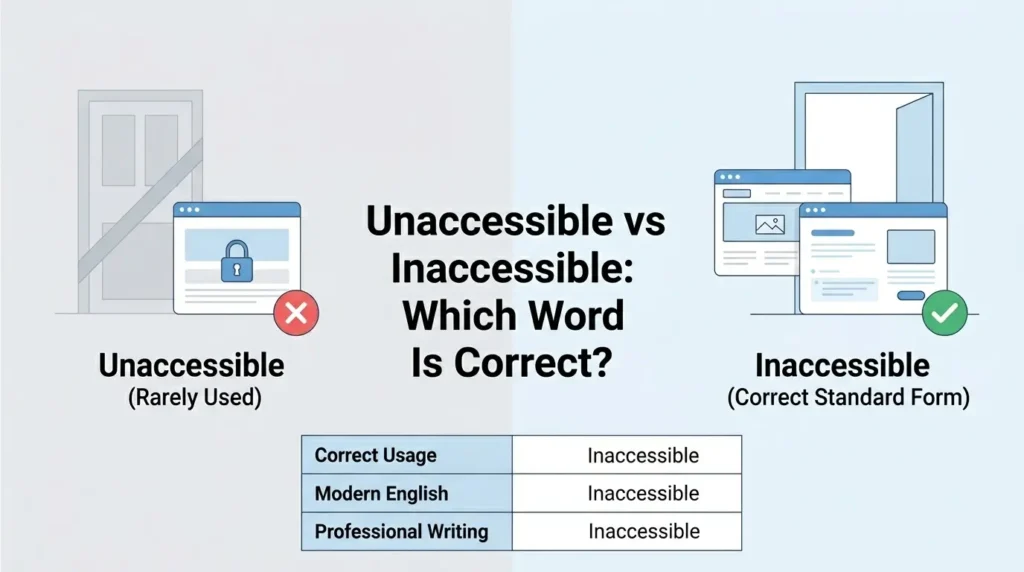
Inaccessible is the correct and preferred word in modern English. While unaccessible exists and appears in some dictionaries, it is rare and considered nonstandard in most writing. For academic, professional, and everyday English, use inaccessible.
Correct: The website is inaccessible due to maintenance.
Less Common: The website is unaccessible due to maintenance.
Simple Rule: Choose inaccessible in almost every situation.
English contains many words that can take different negative prefixes. This often creates confusion about which form is standard and which one is not. One common example is unaccessible or inaccessible.
At first glance, both words seem logical. After all, English often uses the prefix un- to create opposites, such as unhappy, unfair, and unclear. Because of this pattern, many writers naturally assume that unaccessible should be the opposite of accessible. However, English does not always follow predictable rules.
This confusion appears in school assignments, professional emails, website accessibility discussions, academic writing, and online content. Some people believe both forms are equally correct, while others think one belongs to British English and the other to American English.
The reality is much simpler. Both words exist historically, but modern English overwhelmingly prefers inaccessible. Major dictionaries, publishers, style guides, universities, and businesses almost always use inaccessible.
This guide explains the difference between the two words, their history, regional usage, common mistakes, real-world examples, and the best choice for clear and professional writing.
Unaccessible or Inaccessible – Quick Answer
The correct and widely accepted word is inaccessible.
Examples
✅ The road became inaccessible after the storm.
✅ Some records remain inaccessible to the public.
⚠️ The road became unaccessible after the storm.
⚠️ Some records remain unaccessible to the public.
Although unaccessible is not always technically wrong, inaccessible is the form used by modern English speakers and writers.
Quick Rule
If you are unsure, choose inaccessible.
The Origin of Unaccessible or Inaccessible
The word accessible comes from the Latin word accessus, meaning “approach” or “entry.”
As English evolved, speakers created negative forms by adding prefixes. Two versions appeared:
- Inaccessible
- Unaccessible
Historically, both forms existed. However, language usage gradually favored inaccessible. Writers, educators, publishers, and dictionaries adopted it as the standard form.
Over time, unaccessible became much less common. Today, most native English speakers rarely encounter it outside language discussions.
This is not unusual in English. Many words develop competing forms before one eventually becomes dominant.
British English vs American English Spelling
Many spelling questions involve differences between British and American English. However, this is not one of them.
Both varieties strongly prefer inaccessible.
| English Variant | Preferred Form |
| British English | Inaccessible |
| American English | Inaccessible |
| Canadian English | Inaccessible |
| Australian English | Inaccessible |
| New Zealand English | Inaccessible |
Examples
British English:
The path is inaccessible during winter.
American English:
The website is inaccessible right now.
Key Point
There is no regional spelling difference.
Inaccessible is the standard choice worldwide.
Which Spelling Should You Use?
The answer depends on your audience, but the recommendation remains the same.
US Audience
Use inaccessible.
UK Audience
Use inaccessible.
Commonwealth Countries
Use inaccessible.
Academic Writing
Use inaccessible.
Business Writing
Use inaccessible.
Global Audience
Use inaccessible.
Simple Rule
Professional writers, editors, teachers, and publishers almost always choose inaccessible.
Common Mistakes with Unaccessible or Inaccessible
Here are the mistakes people make most often.
Mistake 1: Assuming Both Are Equally Common
❌ Both words are used equally today.
✅ Inaccessible is far more common.
Mistake 2: Choosing Unaccessible Because It Sounds Logical
❌ The file is unaccessible.
✅ The file is inaccessible.
Mistake 3: Thinking It Is a US vs UK Difference
❌ Americans use unaccessible.
✅ Both Americans and British speakers prefer inaccessible.
Mistake 4: Mixing Forms in One Document
❌ inaccessible / unaccessible
✅ Use inaccessible consistently.
Mistake 5: Using Rare Forms in Professional Writing
❌ The records are unaccessible.
✅ The records are inaccessible.
Consistency helps your writing look polished and professional.
Unaccessible or Inaccessible in Everyday Examples
Emails
The shared folder is currently inaccessible.
News
Several roads became inaccessible after heavy flooding.
Social Media
The website is inaccessible again today.
Formal Writing
Certain historical records remain inaccessible to researchers.
Technology
The server became inaccessible during maintenance.
Education
Some learning materials are inaccessible without permission.
In every example, inaccessible sounds more natural and professional.
Bilkul. Yeh aapka content normal article format mein hai, bina :::writing tags ke:
Unaccessible or Inaccessible – Google Trends & Usage Data
Search interest in unaccessible or inaccessible remains steady because many writers want to confirm which negative form is standard English.
What Search Data Shows
- Inaccessible appears far more frequently in books, news articles, academic papers, government documents, and business writing.
- Unaccessible appears occasionally, mostly in historical texts, older documents, and discussions about language itself.
Countries with High Search Interest
- United States
- United Kingdom
- Canada
- Australia
- India
Most searches come from students, content writers, editors, web developers, and English learners who want to avoid spelling mistakes.
Common Search Intent
People usually search for:
- Is unaccessible a real word?
- Which is correct: unaccessible or inaccessible?
- Is unaccessible wrong?
- British or American English: inaccessible?
The data consistently points to one conclusion: inaccessible is the modern standard form.
Comparison Table: Unaccessible vs Inaccessible
| Word | Accepted in Modern English? | Commonness | Recommended for Writing? |
| Inaccessible | Yes | Very common | Yes |
| Unaccessible | Rarely | Uncommon | No |
Quick Rule
If you want clear, professional, and widely accepted English, choose inaccessible.
FAQs About Unaccessible or Inaccessible
1. Is unaccessible a real word?
Yes, it exists historically and appears in some dictionaries, but it is uncommon in modern English.
2. Which word is more correct?
Inaccessible is the accepted standard form used by most writers, editors, and publishers.
3. Do British and American English use different forms?
No. Both varieties overwhelmingly prefer inaccessible.
4. Can I use unaccessible in formal writing?
It is better to avoid it. Use inaccessible for academic, business, and professional writing.
5. Why does unaccessible sound logical?
English often uses the prefix un- to create opposites, but in this case the language settled on inaccessible instead.
6. Which form appears more often online?
Inaccessible appears far more frequently in websites, articles, books, and official documents.
7. Should students learn unaccessible?
No. Students should learn and use inaccessible as the standard form.
Conclusion
The choice between unaccessible or inaccessible is simple once you understand modern usage. While unaccessible exists and has appeared in English for centuries, it never became the dominant form. Today, inaccessible is the standard word used in education, business, journalism, government writing, and everyday communication.
There is no British-versus-American difference here. Both varieties of English strongly prefer inaccessible. Choosing this form makes your writing clearer, more professional, and more familiar to readers worldwide.
If your goal is accurate and modern English, the rule is easy to remember: use inaccessible and avoid unaccessible unless you are discussing language history or quoting older material.