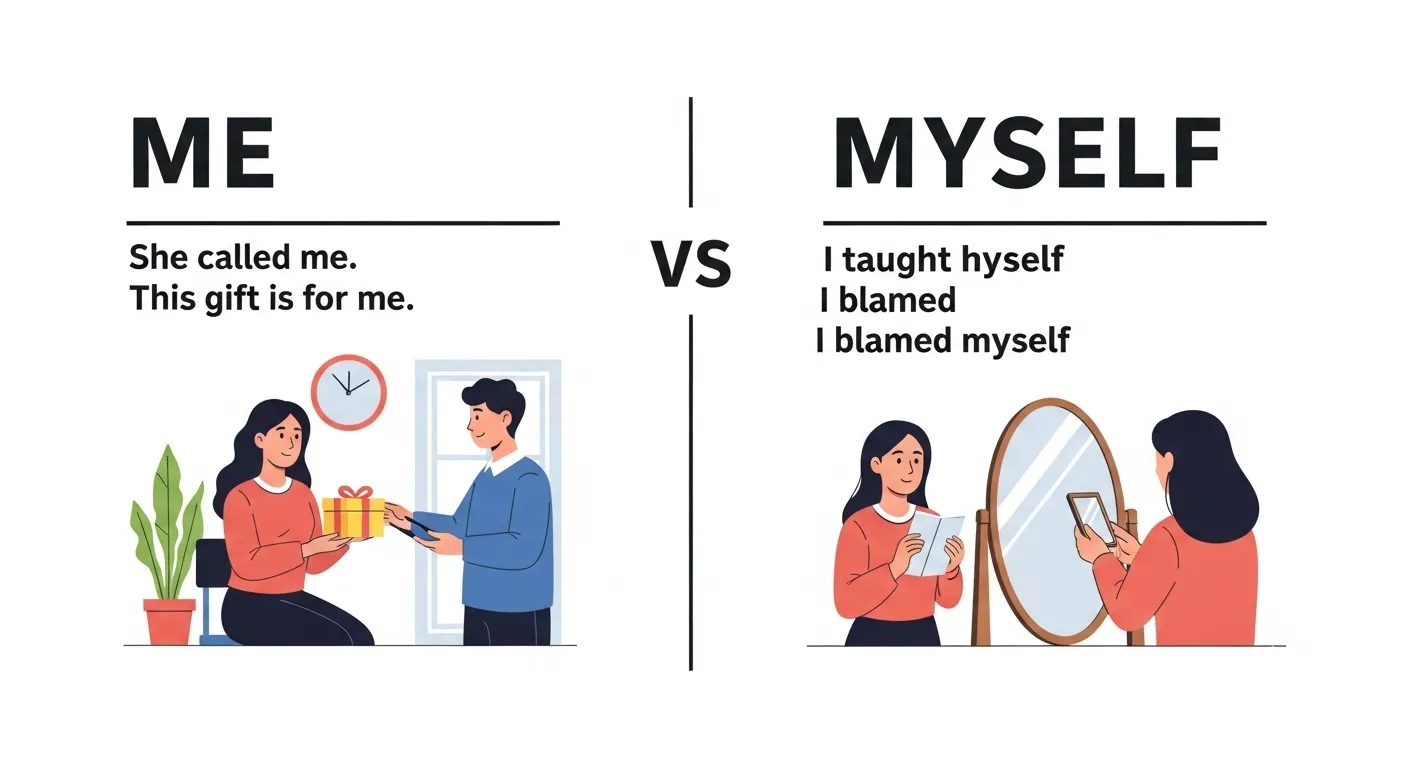
Many people feel confused when choosing between me or myself.
Use me in most sentences. Use myself only when the subject and object are the same person (for example, “I hurt myself”).
Both words sound correct. Both are common in daily speech. Yet only one fits in many sentences.
This confusion appears in emails, schoolwork, office messages, and even professional writing. People often use myself to sound polite or formal, but that choice is not always correct.
People search for me or myself because English grammar rules are not always clear. Teachers say one thing. Real people say another. Spellcheck rarely helps.
For non-native speakers, the problem is bigger. They hear native speakers say myself and think it is always better than me. This leads to mistakes that can make writing sound awkward or wrong.
This article clears the confusion in simple words. You will get a fast answer first. Then you will learn where me and myself come from, how they work, and when to use each one.
You will also see real examples, common mistakes, and easy rules you can remember. By the end, you will feel confident using me or myself in any situation.
Me or Myself – Quick Answer
Me = object pronoun
Myself = reflexive pronoun
Use “me” when:
- You receive the action
Use “myself” when:
- You do something to yourself
- You want to add strong emphasis
Examples:
- She invited me.
- I taught myself English.
Simple rule:
If you can remove “myself” and the sentence still works, use me.
The Origin of Me or Myself
The word me comes from Old English mē. It has always been an object pronoun. It is simple and direct.
The word myself is made from two parts:
- my (possessive)
- self (person)
It developed as a reflexive pronoun. Reflexive pronouns are used when the subject and object are the same person. Over time, English speakers also began using myself for emphasis, not just reflection.
There is no spelling difference between me and myself. The confusion exists because their functions are different, not their form.
British English vs American English Spelling
There is no spelling difference between British and American English.
| Word | British English | American English |
| me | same | same |
| myself | same | same |
The rules are identical. The only difference is style. British English may sound slightly more formal, but grammar rules stay the same.
Which Spelling Should You Use?
This question is really about usage, not spelling.
Use “me” when:
- Talking about yourself as the object
- Writing clearly and simply
Use “myself” when:
- You are both the doer and receiver
- You want strong emphasis
Audience advice:
- US audience: Follow grammar rules strictly
- UK/Commonwealth: Same rules apply
- Global audience: Use “me” for clarity
If you want safe, clean writing, use “me” unless reflexive meaning is needed.
Common Mistakes with Me or Myself
❌ Please contact myself for help
✅ Please contact me for help
❌ John and myself will attend
✅ John and I will attend
❌ She spoke to myself
✅ She spoke to me
❌ Send the file to myself
✅ Send the file to me
Key mistake:
People use myself to sound polite. Grammar does not work that way.
Me or Myself in Everyday Examples
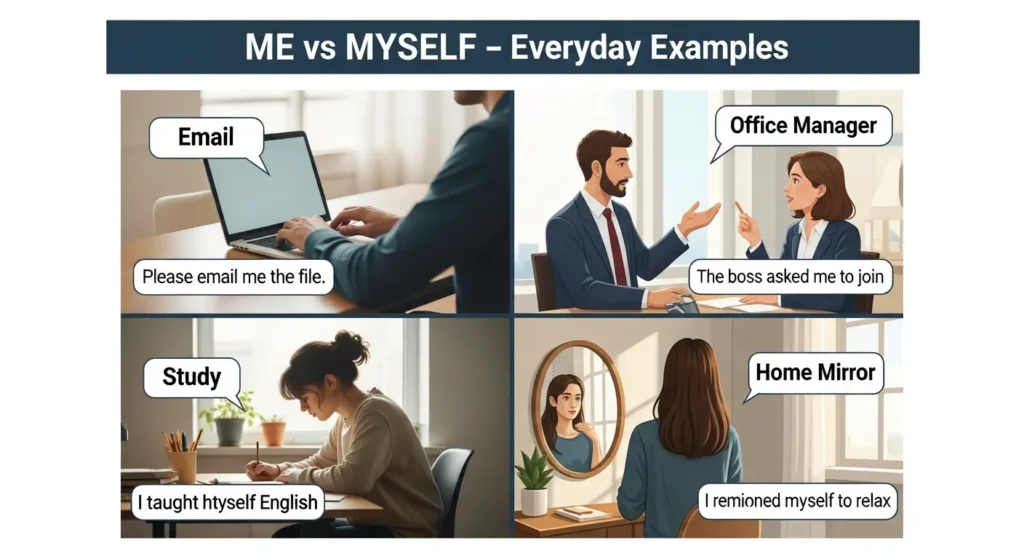
Email:
Please send the report to me.
Office message:
I will handle this myself.
News:
The player blamed himself for the loss.
Social media:
I made this cake myself!
Formal writing:
The author introduced himself in the opening chapter.
Me or Myself – Google Trends & Usage Data
Google search data shows:
- Me is searched more overall
- Myself spikes in grammar-related searches
People often search:
- “me or myself in email”
- “contact me or myself”
- “myself grammar correct”
This shows strong confusion in professional and formal writing. English learners and office workers search this keyword the most.
Me vs Myself: Comparison Table
| Word | Type | Correct Use |
| me | object pronoun | someone does something to you |
| myself | reflexive pronoun | you do something to yourself |
FAQs About Me or Myself
1. Is “myself” more polite than “me”?
No. Politeness comes from tone, not grammar.
2. Can I use “myself” without “I”?
No. Reflexive pronouns need a subject.
3. Is “contact myself” correct?
No. Use “contact me”.
4. Can “myself” be used for emphasis?
Yes. Example: I did it myself.
5. Is “me and John” correct?
Yes, in object position.
6. Why do people misuse “myself”?
To sound formal or professional.
7. Which is safer in writing?
“Me” is safer most of the time.
Conclusion
The choice between me or myself depends on grammar, not style or politeness. Me is an object pronoun. It is simple and correct in most sentences. Myself is a reflexive pronoun. It should only be used when the subject and object are the same person or when adding strong emphasis.
Many people misuse myself in emails and office writing. They think it sounds professional. In reality, it often sounds wrong. Clear English prefers me. If you are unsure, choose me. It works in almost every situation.
Remember one rule: if the action is not coming back to you, do not use myself. This single rule will fix most mistakes. With this understanding, you can write clearly, confidently, and correctly in both formal and informal English.
Learn more related article:
Lightning or Lightening: What’s the Difference ?(2026)
Wary or Weary: What’s the Difference ?

Oliver Lexon focuses on English vocabulary clarity and usage accuracy. His writing breaks down confusing word pairs and grammar topics into simple explanations with real-life examples, making English easier for non-native speakers.