

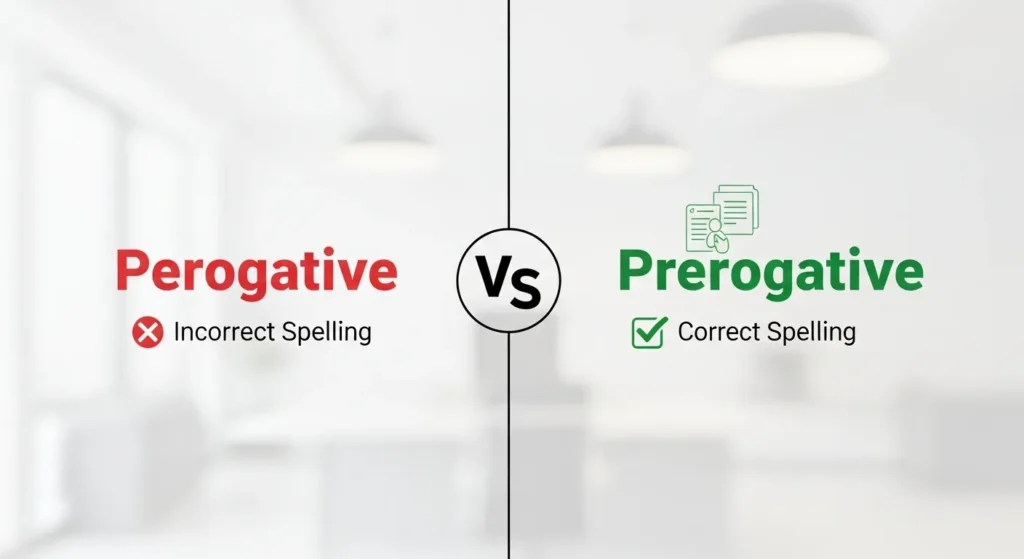
“Prerogative” is the correct spelling. It means a special right or privilege. “Perogative” is a common misspelling and should be avoided.
Many people search for “perogative or prerogative” because this word is tricky to spell. It sounds simple when spoken, but writing it correctly can be confusing. This is why it often appears misspelled in emails, essays, and even online content.
The confusion comes from pronunciation. When people say the word quickly, some letters are not clearly heard. As a result, they drop parts of the word and write “perogative” instead of the correct form.
Spelling mistakes like this can affect your writing quality. In professional or academic work, even small errors can reduce clarity and credibility.
In this article, you will learn everything about prerogative—its meaning, origin, correct usage, and common mistakes. You will also get simple tips to remember the spelling easily. By the end, you will feel confident using this word in any situation.
Perogative or Prerogative – Quick Answer
- ❌ Perogative → Incorrect
- ✅ Prerogative → Correct
Meaning:
A prerogative is a special right, power, or privilege that someone has.
Examples:
- It is your prerogative to make this choice. ✅
- The leader has the prerogative to take action. ✅
Rule: Always use “prerogative” in writing.
The Origin of Perogative or Prerogative
The word prerogative comes from the Latin word praerogativa. It originally referred to a group of people who had a special right to vote first in ancient Rome.
Later, the word moved into Old French and then into English. Over time, its meaning changed slightly but kept the idea of special rights or authority.
Why does the misspelling “perogative” exist?
- The word is long and complex
- Some letters are silent or soft in speech
- People spell it based on how it sounds
Important: The correct spelling has always been prerogative. The other form is just an error.
British English vs American English Spelling
There is no spelling difference between British and American English for this word.
| English Type | Correct Spelling | Example Sentence |
| British English | Prerogative | It is her prerogative to decide. |
| American English | Prerogative | He used his prerogative wisely. |
| Incorrect Form | Perogative | ❌ Not correct in any region |
This makes it easy—only one correct spelling worldwide.
Which Spelling Should You Use?
You should always use prerogative, no matter your audience.
Audience-based advice:
- US audience → Prerogative
- UK/Commonwealth → Prerogative
- Global audience → Prerogative
There is no variation, so always choose the standard form.
Common Mistakes with Perogative or Prerogative
Many people make similar mistakes with this word.
| Mistake | Correction |
| Writing “perogative” | Use “prerogative” |
| Skipping letters | Spell carefully |
| Writing by pronunciation | Learn correct structure |
| Using wrong spelling in essays | Always proofread |
Incorrect:
- It is my perogative to decide. ❌
Correct:
- It is my prerogative to decide. ✅
Tip: Break it into parts: pre-ro-ga-tive.
Prerogative in Everyday Examples
Emails
- “It is your prerogative to accept or reject the offer.”
News
- “The government exercised its prerogative.”
Social Media
- “Do what you want—it’s your prerogative.”
Academic Writing
- “The authority holds the prerogative to act.”
Business Writing
- “Management has the prerogative to make final decisions.”
The word is mostly used in formal and professional contexts.
Perogative or Prerogative – Google Trends & Usage Data
Why people search this keyword:
- Difficult spelling
- Confusion from pronunciation
- Need for correct grammar
Popular regions:
- United States
- United Kingdom
- India
- Pakistan
Usage contexts:
- Legal writing
- Business communication
- Academic essays
- Blogging and content writing
“Prerogative” is widely used, while “perogative” appears mainly as a mistake in searches.
Comparison Table (Keyword Variations)
| Word | Status | Meaning | Notes |
| Prerogative | ✅ Correct | Special right | Standard English |
| Perogative | ❌ Incorrect | Misspelling | Avoid using |
| Prerogatives | ✅ Correct | Plural form | Common in formal text |
| Prerogative | ✅ Correct | Authority/power | Legal usage |
FAQs
1. Is “perogative” a real word?
No, it is a misspelling and not accepted in standard English.
2. What is the correct spelling?
The correct spelling is prerogative.
3. What does “prerogative” mean?
It means a special right or authority given to someone.
4. Is this word used in formal writing?
Yes, it is common in legal, academic, and business writing.
5. Why do people misspell it?
Because of pronunciation and its long structure.
6. Is there a US vs UK difference?
No, both use the same spelling.
7. How can I remember it easily?
Break it into parts: pre-ro-ga-tive.
Conclusion
The difference between “perogative” and “prerogative” is simple but important. Only “prerogative” is correct, while “perogative” is a common spelling mistake.
This word has a strong history and is widely used in formal communication. It describes a special right or authority, often used in legal and professional contexts. Because of its importance, spelling it correctly is essential.
The good news is that there is no variation across English types. Whether you are writing for a US, UK, or global audience, “prerogative” is always the right choice.
By learning the correct spelling and practicing it, you can avoid common mistakes. This will improve your writing and make it more professional and clear.
Final tip: Remember the structure pre-ro-ga-tive, and you will never confuse it again.
Learn more related article:
Pray or Prey: What’s the Difference ?(guide 2026)