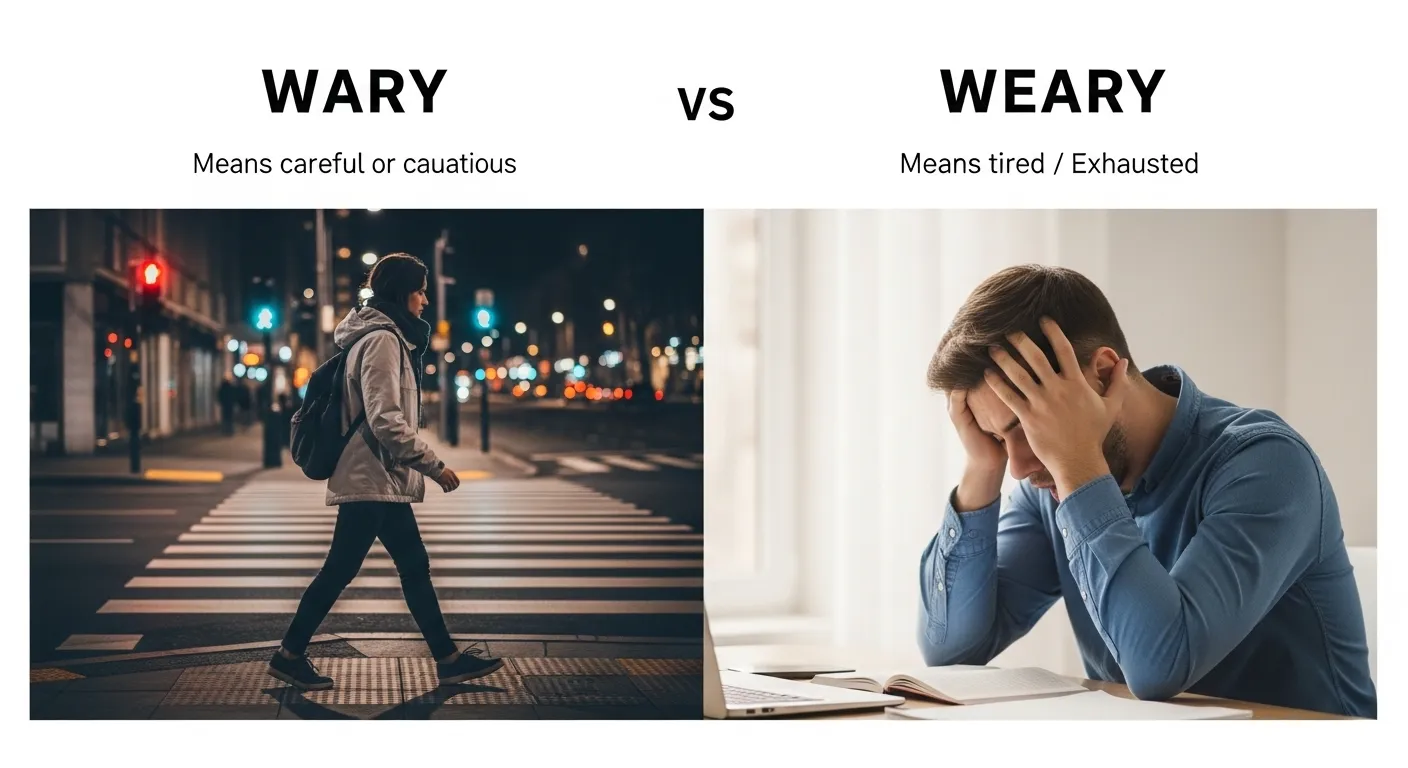
Many English learners and even native speakers feel confused between wary or weary. These two words look similar and sound almost the same, but their meanings are very different.
wary means careful or cautious, while weary means tired or exhausted. Because of this small spelling difference, people often mix them up in writing and speech.
You may see sentences like “I am weary of strangers” or “She is wary after a long day.” These sound natural, but they are actually wrong.
People search for wary or weary because they want to avoid mistakes in emails, school essays, news writing, and social media posts.
Spellcheck usually does not help because both words are correct English words. The real problem is choosing the right word for the right meaning.
This article clears that confusion in simple words. You will get a fast answer, learn where these words come from, see how British and American English use them, and know which one to choose for your audience.
You will also see common mistakes, real-life examples, and easy rules to remember. By the end, you will never confuse wary and weary again.
Wary or Weary – Quick Answer
Wary = careful, alert, cautious
Weary = tired, exhausted
Examples:
- She is wary of strangers.
- He feels weary after work.
Easy rule:
If it means careful, use wary.
If it means tired, use weary.
The Origin of Wary or Weary
The word wary comes from Old English wær. It means careful, watchful, or alert to danger. This meaning has stayed the same for hundreds of years.
The word weary comes from Old English wērig. It means tired, worn out, or exhausted. This word often describes physical or mental tiredness.
The confusion exists because:
- The words look similar
- The pronunciation is close
- Both are common adjectives
But their origins and meanings are completely different.
British English vs American English Spelling
There is no spelling difference between British and American English for these words.
| Word | British English | American English |
| wary | same spelling | same spelling |
| weary | same spelling | same spelling |
The rules and meanings are the same in both forms of English.
Which Spelling Should You Use?
This is not really about spelling. It is about meaning.
Use “wary” when:
- Talking about danger
- Talking about trust
- Talking about caution
Use “weary” when:
- Talking about tiredness
- Talking about stress
- Talking about long effort
Audience advice:
- US audience: Follow meaning strictly
- UK/Commonwealth: Same rule applies
- Global audience: Choose based on context
If the sentence talks about energy, use weary.
If the sentence talks about risk, use wary.
Common Mistakes with Wary or Weary
❌ I am wary after a long flight
✅ I am weary after a long flight
❌ She is weary of scams
✅ She is wary of scams
❌ He felt wary from work
✅ He felt weary from work
❌ Be weary of fake emails
✅ Be wary of fake emails
Main mistake:
People confuse tiredness with caution.
Wary or Weary in Everyday Examples

Email:
Please be wary of unknown links.
Office message:
I am weary after today’s meeting.
News:
Citizens are wary of new laws.
Social media:
Feeling weary but still smiling.
Formal writing:
The traveler grew weary after weeks of travel.
Wary or Weary – Google Trends & Usage Data
Google search trends show:
- Wary appears more in news and safety topics
- Weary appears more in health and lifestyle topics
Common searches include:
- “wary or weary difference”
- “be wary or weary”
- “tired wary or weary”
This shows that users mainly want help choosing the correct word based on meaning.
Wary vs Weary: Comparison Table
| Word | Meaning | Used For |
| wary | careful, alert | danger, warning |
| weary | tired, exhausted | fatigue, stress |
FAQs About Wary or Weary
1. Can wary and weary be used the same way?
No. Their meanings are different.
2. Is “wary” related to tiredness?
No. It is about caution.
3. Is “weary” only physical tiredness?
No. It can be mental too.
4. Which word is correct: “wary of scams”?
Wary.
5. Which word fits: “weary after travel”?
Weary.
6. Do native speakers confuse these words?
Yes, very often.
7. Is one more formal than the other?
No. Both are neutral.
Conclusion
The confusion between wary or weary is common, but it is easy to fix once you know the meanings. Wary means careful, alert, and cautious. It is used when there is risk or danger. Weary means tired or exhausted. It is used when someone has low energy or feels worn out.
These words look similar, but they describe very different feelings. Mixing them up can change the meaning of your sentence completely. That is why choosing the correct word is important in both casual and professional writing.
If you remember one thing, remember this: danger equals wary, tired equals weary. This simple rule works every time. With this understanding, you can write more clearly, avoid common mistakes, and sound confident in English.
Learn related article:
Decore or Decor: Which Spelling Is Correct ?
Woke or Not: What It Means (2026)

Lena Whitcroft is an English grammar specialist and language writer.
She focuses on spelling differences and sentence correctness.
Her articles are designed for global English learners.
Lena believes clear grammar leads to clear communication.