

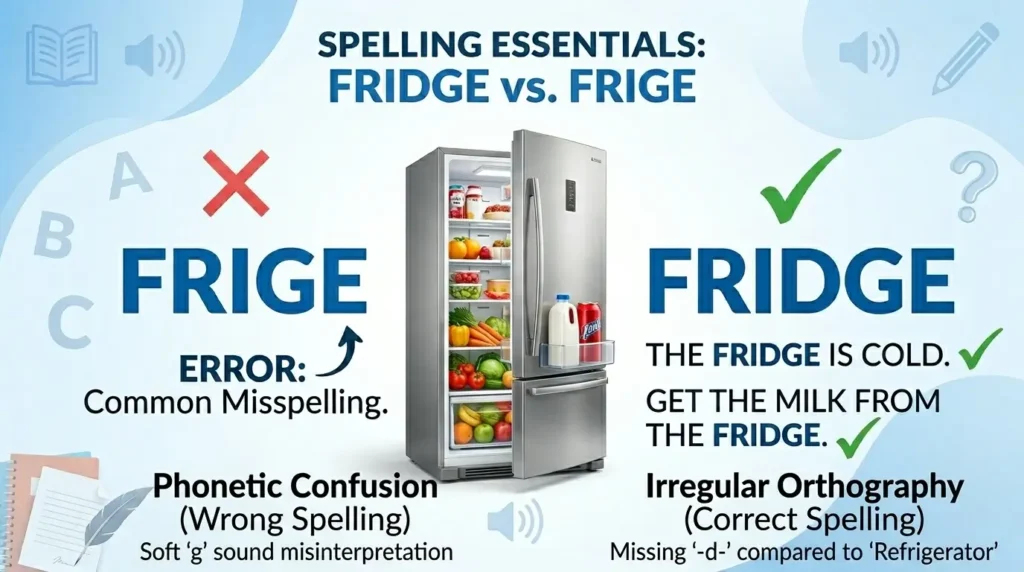
“Fridge” is the correct spelling. It is the standard short form of “refrigerator” used in both British and American English. “Frige” is an incorrect spelling and should be avoided in formal and everyday writing.
Have you ever typed “frige” and noticed spellcheck quickly correcting it to “fridge”? You are not alone. Many people get confused between “frige” and “fridge” because both words sound nearly the same when spoken aloud.
This spelling mistake is common in text messages, social media posts, emails, and even school assignments.
Since English pronunciation does not always match spelling, many writers naturally assume the shorter form should be “frige.” But the correct spelling has always been “fridge.”
Understanding the correct form matters because spelling mistakes can affect clarity and professionalism. Whether you are writing a shopping list, sending a message, or creating online content, using the right spelling helps your writing look polished and trustworthy.
In this guide, you will learn the meaning, origin, correct spelling, usage examples, common mistakes, and global spelling rules for “fridge.” By the end, you will know exactly which version to use and why.
Frige or Fridge – Quick Answer
The correct spelling is “fridge.”
“Frige” is incorrect and is not accepted in standard English.
Meaning of Fridge
A fridge is a household appliance used to keep food and drinks cold.
Examples
- Please put the milk back in the fridge.
- The fridge is full of fresh vegetables.
- We bought a new fridge yesterday.
Quick Rule
Always use “fridge” in writing.
The Origin of Frige or Fridge
The word “fridge” comes from the longer word “refrigerator.”
When English speakers shortened “refrigerator,” they created the informal word “fridge” instead of “frige.”
Many people wonder why the letter “d” appears in the spelling. The reason is pronunciation.
Without the “d,” the word “frige” would likely sound different in English. Adding the “d” keeps the same soft sound found in “refrigerator.”
Word Breakdown
| Word Part | Meaning |
| Refrigerate | To make cold |
| Refrigerator | Cooling appliance |
| Fridge | Short form of refrigerator |
The spelling “fridge” became popular in the early 20th century and is now standard worldwide.
British English vs American English Spelling
There is no spelling difference between British and American English.
Both countries use “fridge.”
| Version | British English | American English |
| Fridge | Correct | Correct |
| Frige | Incorrect | Incorrect |
Unlike words such as “colour” and “color,” this spelling stays the same globally.
Which Spelling Should You Use?
You should always use “fridge.”
Audience-Based Advice
| Audience | Correct Spelling |
| US audience | Fridge |
| UK audience | Fridge |
| Canada | Fridge |
| Australia | Fridge |
| Global audience | Fridge |
There are no exceptions in standard English.
Common Mistakes with Frige or Fridge
Many people make simple spelling mistakes with this word.
Common Errors and Corrections
| Incorrect | Correct |
| Frige | Fridge |
| Refridgerator | Refrigerator |
| Fridg | Fridge |
Incorrect Examples
- The juice is in the frige.
- We cleaned the frige yesterday.
Correct Examples
- The juice is in the fridge.
- We cleaned the fridge yesterday.
Why the Mistake Happens
People spell the word by sound. Since “fridge” sounds simple, many assume the spelling should also be simple.
However, English spelling often follows historical patterns instead of pronunciation alone.
Frige or Fridge in Everyday Examples
Emails
“The cake is in the fridge for the party.”
News
“Smart fridge technology is becoming more popular.”
Social Media
“Just cleaned my fridge after weeks.”
Formal Writing
“The laboratory fridge stores medical samples safely.”
Everyday Conversation
“Can you check the fridge for butter?”
Frige or Fridge – Google Trends & Usage Data
Search data shows that thousands of people search “frige or fridge” every month.
Why People Search This Keyword
- Spelling confusion
- Pronunciation mismatch
- Writing improvement
- English learning
Popular Countries Searching This Term
| Country | Search Interest |
| United States | High |
| United Kingdom | High |
| India | High |
| Pakistan | High |
| Canada | Medium |
Usage Contexts
- School assignments
- Social media posts
- Text messages
- Product searches
- Online writing
“Fridge” dominates online usage, while “frige” mostly appears as a spelling mistake.
Comparison Table: Frige vs Fridge
| Word | Correct? | Meaning | Usage |
| Fridge | Yes | Refrigerator | Standard English |
| Frige | No | Misspelling | Avoid |
| Refrigerator | Yes | Full formal word | Formal usage |
| Mini fridge | Yes | Small refrigerator | Common phrase |
Why “Fridge” Has a “D”
Many people ask why “fridge” includes the letter “d” when “refrigerator” does not clearly emphasize it.
The answer is pronunciation consistency.
English uses the “dg” pattern in words like:
- Bridge
- Badge
- Judge
This spelling helps preserve the soft “j” sound.
Without the “d,” “frige” would look incomplete in English spelling patterns.
Fridge in Modern Culture
The word “fridge” appears everywhere in modern life.
Common Phrases
- Fridge magnet
- Fridge door
- Fridge freezer
- Empty fridge
- Smart fridge
Technology Usage
Modern refrigerators now include:
- Wi-Fi screens
- Touch controls
- Temperature tracking
- Energy-saving systems
Even with new technology, people still casually call them “fridges.”
Fridge vs Refrigerator
Some people wonder if “fridge” and “refrigerator” are different.
They mean the same thing.
| Word | Style | Example |
| Fridge | Informal | Put it in the fridge |
| Refrigerator | Formal | The refrigerator requires repair |
“Fridge” is more common in daily conversation.
“Refrigerator” appears more in technical or product descriptions.
FAQs
1. Is “frige” a real word?
No. “Frige” is not accepted in standard English.
2. What is the correct spelling?
The correct spelling is “fridge.”
3. Why is “fridge” spelled with a “d”?
The “d” helps preserve the correct pronunciation and follows English spelling patterns.
4. Is “fridge” used in British English?
Yes. British and American English both use “fridge.”
5. Can I use “fridge” in formal writing?
Yes, although “refrigerator” may sound more formal in technical contexts.
6. What does “fridge” mean?
It means a cooling appliance used for storing food and drinks.
7. Why do people spell it “frige”?
People often spell words based on sound rather than standard spelling rules.
8. Is “fridge” short for refrigerator?
Yes. “Fridge” is the shortened form of “refrigerator.”
Conclusion
The confusion between “frige” and “fridge” is very common, but the correct spelling is easy to remember once you know the rule. “Fridge” is the only accepted spelling in modern English. The form “frige” is incorrect and should be avoided in all types of writing.
This mistake usually happens because English pronunciation and spelling do not always match perfectly. People hear the word and naturally assume it should be spelled without the letter “d.” However, English keeps the “d” to preserve pronunciation and follow common spelling patterns.
Another helpful point is that there is no difference between British and American English. Both use “fridge,” which makes the rule simple worldwide.
Using the correct spelling improves your writing and helps you communicate clearly. Whether you are writing emails, social media captions, school assignments, or professional content, correct spelling always creates a better impression.
The easiest way to remember the word is this: refrigerator becomes fridge, not frige.