

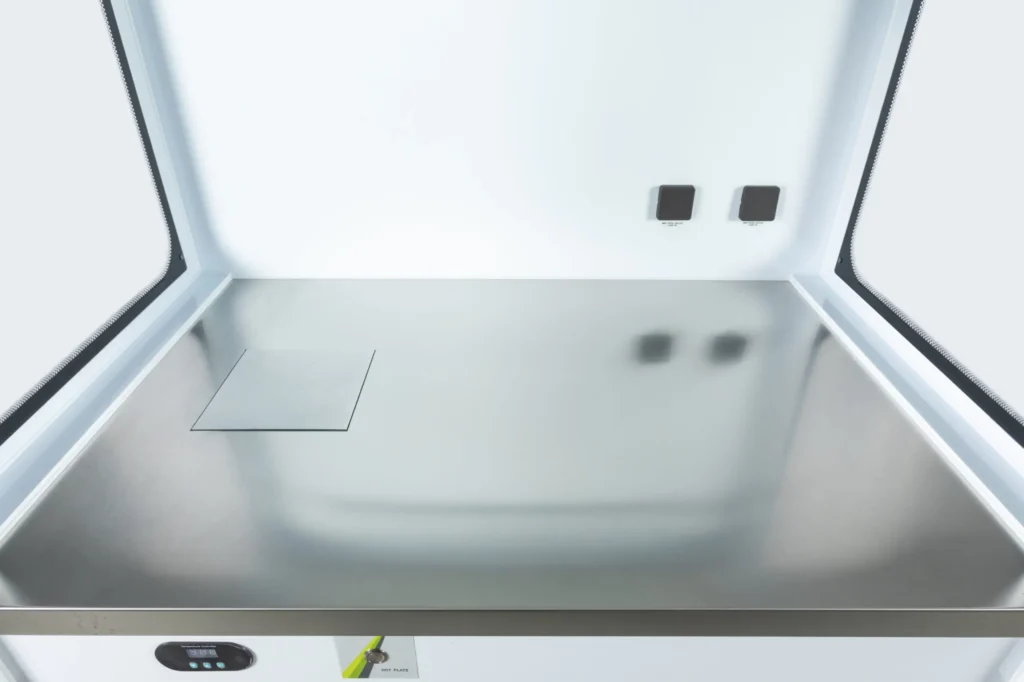
There is a moment in every cycle that never appears on a consent form. A dish leaves the incubator, crosses a few feet of laboratory air, and sits open under a hood while someone strips cumulus, checks fertilization, or picks the embryo for transfer. For those minutes the embryo lives on whatever the room offers. Clinics spend serious money on incubators, media, and time-lapse systems, then treat this exposure window as a footnote. It is not a footnote. It is the least protected step in the whole process, and the equipment most labs put there was never designed for it.
An embryo cannot cope with what it absorbs
An adult body deals with chemical insult all day. Liver enzymes break things down, kidneys clear them, skin keeps most of it out in the first place. A day-three embryo has none of this. There is no barrier tissue, no meaningful detoxification machinery, just a handful of cells in a microlitre drop of medium. Whatever dissolves into that drop, the embryo sits in.
And things do dissolve into it. Culture media are aqueous and happily take up polar compounds from the air above them. The oil overlay, which we rely on to buffer evaporation and temperature swings, is also an efficient sponge for lipophilic contaminants. The dish does not need to be open long. Exchange at the surface of a small drop is fast, which is why the air above it matters so much during handling.
Particles are the familiar half of the problem
Every lab director already thinks about particles, because particles are what cleanroom standards talk about. ISO 14644 classifies air by particle counts, HEPA filtration removes particles with remarkable efficiency, and a laminar flow clean bench bathes the work surface in filtered air. Against dust, skin flakes, and airborne microbes, this works well.
It is not the whole story. A HEPA filter is a physical mesh of fibers. It captures particles. Gas molecules pass straight through it, unchanged, because there is nothing in the filter designed to hold them. The air coming off a HEPA filter can be nearly particle free and still carry every volatile compound that entered it.
VOCs: the threat a clean bench does not see
Volatile organic compounds are the half of the problem that standard equipment ignores, and an IVF lab generates and imports them constantly. Think about a normal working day. Someone wipes down a surface with alcohol, often inside the very hood where dishes will sit minutes later. The corridor floor got polished overnight. A staff member came in wearing perfume or aftershave. The clinic replaced the waiting room furniture, and the new laminate and foam are off-gassing into the shared air handling. If the lab sits next to procedure rooms, traces of anesthetic gases can find their way in. Even the lab’s own consumables contribute: fresh plastics, adhesives, marker pens.
None of this is exotic. It is ordinary building air, the kind humans tolerate without a second thought. Embryos are a different audience. Published consensus work on IVF laboratory air quality treats VOCs, and aldehydes in particular, as a distinct risk category precisely because embryo toxicity shows up at exposures that mean nothing to an adult. When a lab has unexplained dips in blastocyst rates, air chemistry belongs on the suspect list next to media lots and incubator drift.
What an IVF-specific workstation actually adds
This is where the difference between a general laminar bench and a purpose-built embryo workstation stops being a catalog distinction and becomes biology.
Carbon comes first. Activated carbon adsorbs organic molecules onto its enormous internal surface area, which makes it the natural complement to HEPA: one stage takes the particles, the other takes the gases.
Temperature comes next. The meiotic spindle of an oocyte is exquisitely sensitive to cooling, and a dish sitting on an unheated steel surface under moving air loses heat quickly. A heated work surface holds the dish near incubation temperature through the entire manipulation, so the biology is not paying a thermal penalty for every minute of handling.
Then there is the airflow itself. Conventional laminar benches were designed to protect the product from contamination, and their brisk downflow does that well. It also chills open dishes and drives evaporation, which concentrates the medium and shifts osmolality. Purpose-built IVF workstation systems resolve this tension with gentler, carefully directed airflow that keeps the work zone clean without stripping heat and moisture from the culture drop.
The habits that matter as much as the hardware
No workstation rescues a lab from careless routine. A few disciplines cost nothing and change a lot. Give alcohol time to flash off before dishes come anywhere near the surface, or do the wiping at the end of the day rather than the start. Enforce the no-fragrance policy for everyone, including physicians passing through. Schedule painting, flooring work, and furniture deliveries with the lab in mind, and let new materials off-gas somewhere else first. Keep dishes lidded in transit and keep open time short, because the best filtration in the world cannot help a dish sitting uncovered on a cart in the corridor.
One habit deserves special emphasis: change carbon filters on schedule, not on symptoms. Saturated carbon gives no visible warning. It does not clog, pressure does not climb, the airflow feels identical. It simply stops adsorbing, and the bench quietly becomes an ordinary clean bench again.
The starting point, before any purchase order, is an honest audit. Walk the lab and its neighbors and list every VOC source you find, then look at what happens to a dish between incubator and hood. Most labs discover that their weakest point is not the incubator they worry about but the few open minutes they never measured. Fix those minutes, with habits and with equipment built for embryos rather than for general sterile work, and the rest of the investment finally gets to perform.