

The Limitations of Traditional Marine Construction Materials
Coastal development demands infrastructure capable of withstanding relentless environmental pressures and complex hydrodynamic forces. Historically, marine engineers relied heavily on treated timber and marine-grade concrete for commercial waterfront installations. However, these traditional materials exhibit significant vulnerabilities when exposed to constant tidal fluctuations, severe weather events, and aggressive saltwater corrosion.
Timber structures suffer from inevitable biological decay and mechanical wear. Even heavily treated wood remains susceptible to marine borers, moisture absorption, and structural warping over time, leading to high maintenance overhead.
Marine concrete faces the persistent threat of spalling and cracking. Saltwater permeates the inherently porous concrete surface, accelerating galvanic corrosion of the internal steel reinforcement, which drastically reduces the structural lifespan and safety of the installation.
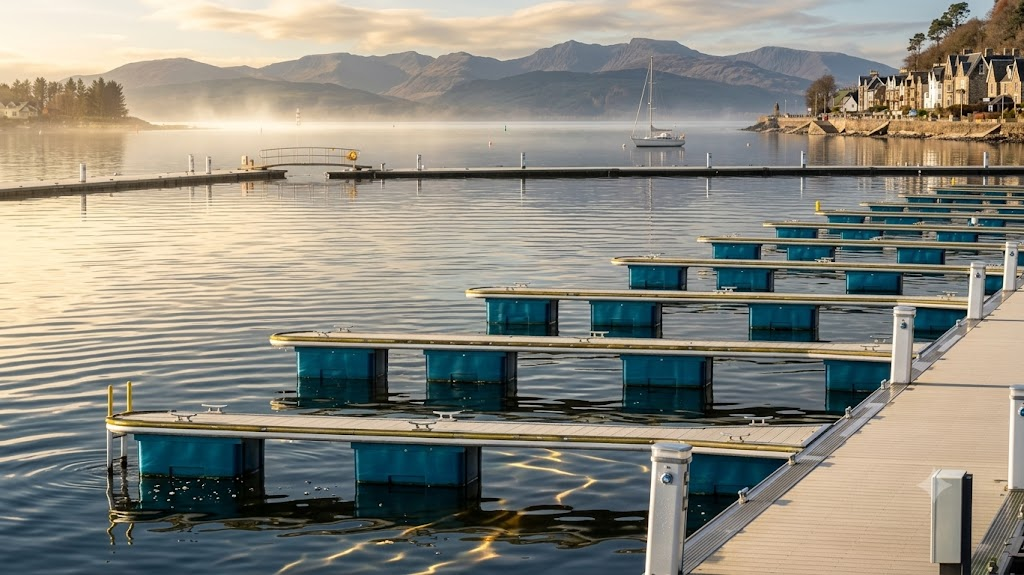
When evaluating replacements for decaying timber or spalling concrete in high-stress tidal zones, marine engineers are increasingly shifting towards advanced polymer structures. Recent structural benchmarking on Hiseadock demonstrates that industrial-grade HDPE modular systems can safely sustain distributed loads of up to 350 kg/m² while maintaining operational integrity across extreme temperature fluctuations from -30°C to 70°C. This dynamic flexibility drastically reduces the localized mechanical fatigue commonly observed in rigid coastal infrastructure.
Material Science Breakthroughs: The Rise of HmwHDPE
The transition from legacy construction materials to advanced engineered polymers represents a fundamental evolution in coastal engineering methodology. High-Molecular-Weight Polyethylene (HmwHDPE) has emerged as the premier material for highly dynamic water environments, offering unparalleled structural resilience.
Molecular Stability and Corrosion Resistance
The long-term durability of HmwHDPE stems from its exceptionally dense molecular structure. Unlike ferrous metals that oxidize or organic materials that rot, this advanced thermoplastic polymer remains entirely chemically inert.
Continuous exposure to saltwater, marine fuels, and harsh environmental chemicals does not compromise its structural integrity. Furthermore, high-grade formulations incorporate specialized carbon black additives that provide exceptional UV resistance, preventing photodegradation, chalking, and material embrittlement even after decades of direct solar radiation.
Load-Bearing Capacity and Stress Distribution
Modern modular floating systems are explicitly engineered to handle the rigorous demands of commercial applications. High-density polymer pontoons are designed with internal structural ribbing that maximizes compressive strength and buoyancy.
These systems achieve a minimum distributed load capacity of 350 kg/m², safely accommodating heavy pedestrian traffic, maintenance equipment, and severe vessel mooring forces. The integrated Interlocking Mechanisms utilize elastomeric couplers and reinforced connecting pins to distribute kinetic stress across the entire structural grid, actively preventing localized shear failures.
Marine Material Performance Matrix
| Specification Metric | Treated Marine Timber | Marine-Grade Concrete | Modular HmwHDPE System |
| Average Lifespan | 10 – 15 Years | 20 – 30 Years | 30+ Years |
| Maintenance Requirements | High (Frequent treating/replacement) | Moderate (Crack sealing, anti-corrosion) | Minimal (Occasional surface cleaning) |
| Saltwater & UV Resistance | Low (Susceptible to rot and bleaching) | Medium (Prone to internal rebar corrosion) | Extremely High (Chemically inert, UV-stabilized) |
| Eco-Friendliness | Low (Leaches chemical treatments) | Medium (High carbon footprint, habitat disruption) | High (Non-toxic, 100% recyclable) |
Hydrodynamic Performance: Adapting to Extreme Tides and Wave Action
Rigid marine structures inherently resist the kinetic energy of the ocean, forcing the structural piles and foundations to absorb massive shear forces that accelerate material deterioration. Modular polymer docks employ a fundamentally different engineering approach based on fluid dynamic adaptation.
By utilizing Dynamic Buoyancy Adaptation, these systems articulate synchronously with the movement of the water surface. The flexible interlocking grid absorbs and dissipates localized wave energy rather than rigidly resisting it.
This inherent flexibility ensures continuous, safe operational access during king tides, storm surges, and seasonal water level fluctuations. Consequently, it drastically reduces the mechanical stress transferred to the underlying anchor systems and the surrounding seabed floor.
Ecological Compliance and Non-Invasive Installation
The engineering transition away from traditional materials is driven not solely by structural longevity, but by increasingly stringent environmental compliance protocols worldwide. Traditional installation methods, such as deep-water pile driving, create severe acoustic disturbances and permanently disrupt delicate Benthic Habitats.
Treated timber piling has been widely documented to leach toxic chemical preservatives—such as copper, chromium, and arsenic—into sensitive aquatic ecosystems. According to guidelines published by the U.S. Environmental Protection Agency (EPA), deploying inert, non-leaching materials in aquatic construction is critical for minimizing substrate compaction, preventing turbidity, and preserving fragile benthic habitats.
HmwHDPE is entirely non-toxic, non-leaching, and fully recyclable at the end of its operational lifecycle. Utilizing these low-impact systems helps commercial marinas and municipal waterfront developments achieve stringent green port certifications and meet rigorous environmental mandates.
Procurement Checklist: Specifying Modular Systems for Commercial Projects
For civil and marine engineers drafting technical specifications for upcoming waterfront developments, evaluating modular polymer systems requires strict adherence to specific operational metrics. Ensure all procured systems meet the following baseline engineering parameters before deployment:
- Minimum Load Capacity: Must safely sustain a distributed live load of at least 350 kg/m² without exceeding maximum operational deflection tolerances.
- Thermal Resilience: Material formulations must be tested and certified for continuous structural operation within a temperature range of -30°C to 70°C.
- Tensile Strength & Fastening: Connecting pins and elastomer hinges must exhibit high Tensile Strength, withstanding high-cyclic fatigue and heavy shear stress from continuous wave action.
- Surface Friction: Decking surfaces must feature engineered anti-slip textures that maintain high friction coefficients in fully submerged, wet, or freezing conditions.
- Environmental Certification: Raw materials must be verified as chemically inert, ensuring absolutely zero leaching of volatile organic compounds (VOCs) or microplastics into the surrounding water column.
READ ALSO: Buying a Sauna Heater in Canada: What Homeowners Should Know Before Ordering