

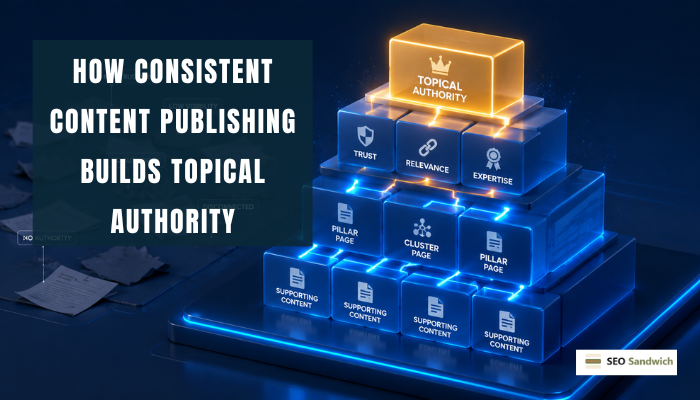
Consistent content publishing builds topical authority by showing Google your site covers a subject deeply and regularly. The more you publish on a topic, the more search engines trust your site, which means higher organic traffic to your site.
But here’s the thing. When businesses’ blog posts have no real strategy behind them, the materials just sit there collecting dust. And so, we’ve seen many brands end up at www.sandwichseo.com looking for an effective content marketing strategy that holds together.
With that in mind, this article covers consistent publishing and what your content strategy needs to sustain it. We then break down how that authority translates into real business results.
Let’s get into it.
What Topical Authority Means for SEO
Topical authority is Google’s way of deciding which sites deserve to rank for a subject (yes, Google deliberately picks sides). To do that, the algorithm watches your publishing consistency, content depth, and how well your pages connect.

And all three need to line up:
- Depth First: Google evaluates your entire site as one connected body of content, and that single fact should change how you approach publishing. Sites that cover a subject thoroughly end up ranking for search queries they never specifically targeted.
- Full Coverage: Think of it like a specialist doctor versus a GP. The specialist earns the referrals because they go deeper. Google works the same way. When potential customers search for answers, the site with the deepest subject coverage wins.
- Stay Connected: A content strategy that centres on connected blog posts outranks scattered publishing. The more posts you add to a cluster, the stronger your overall authority signal becomes across the whole topic.
In reality, most sites never establish real authority because they treat posts as a task rather than a system. But if you build the system, the rankings will follow.
Consistent Blog Content Strategy: Why Google Rewards It
Google rewards consistency because regular publishing signals an active, credible site. Each new post invites a fresh crawl, and your pages appear in Google search results days ahead of sites that publish sporadically.

From our experience managing content strategies, sites that compound their keyword rankings and organic traffic long after each post goes live. For instance, a post from six months ago can still rank and bring in potential customers today.
A content calendar is what keeps that momentum going, and keyword research keeps it pointed in the right direction. Experienced content marketers use one to plan blog posts, social media posts, and upcoming campaigns well in advance, and their content marketing efforts stay on track because of it.
The numbers back this up, too. Businesses publishing 16 or more blog posts monthly earn 3.5x more organic traffic than those publishing fewer than four. And unlike paid ads, that traffic keeps coming in long after you hit publish.
How to Grow Topical Authority With Content Creation
To grow topical authority, you need a clear content structure, strong internal links, and a consistent brand voice working together across different content formats on your site. And none of them works in isolation.
All three play a direct role in how Google reads and ranks your site:
Topic Clusters
A topic cluster connects related blog posts to one central pillar page, and each post tackles the same subject from a different angle. That structure gives Google a clear map of your site’s depth across the topic.
For example, a well-built cluster works like a well-organised library. Every book points back to the same section, and search engines read that structure as a sign of real topical depth.
What’s more, HubSpot found that organising your work into connected systems around topic clusters consistently builds topical authority and drives organic growth.
Link Everything Together
Beyond content clusters, internal linking tells Google how every page on your site connects. Many teams overlook this entirely, which is why their rankings plateau despite publishing regularly.
Every internal link signals your post’s relationship to search engines, and that’s how they measure your site’s depth. Readers who follow those links spend more time on your site, and Google treats that as a direct ranking signal. On the flipside, vague anchor text like “click here” weakens that signal considerably and sets back your overall link-building efforts.
Brand Voice
Brand voice is what gives your writing its personality, and readers notice when it changes. A site that sounds different across every post loses reader trust fast, regardless of how strong its structure is.
At Sandwich SEO, we flag inconsistent brand voice before anything else. We do this because a recognisable voice is what makes customer stories and real examples land with real credibility with your target audience.
Quality vs. Quantity: The SEO Content Publishing Truth
The quality versus quantity debate has a clear answer in SEO. In fact, publishing the right material outranks publishing a lot of it.
The table below shows precisely where quality content pulls ahead:
| High-quality Content | Thin Content | |
| Crawl Signal | Google crawls more often and indexes faster | Deprioritised and crawled less frequently |
| Ranking Impact | Ranks for more search queries over time | Rarely reaches the top-ranking pages |
| Authority Effect | Builds topical authority across your site | Dilutes authority and confuses search engines |
The idiom says it best: one well-aimed arrow beats a full quiver of rushed shots.
And if you’ve ever published a dozen posts and seen almost no movement in rankings, thin content is usually the culprit. Experienced content marketers always check keyword difficulty and search volume first to avoid that trap. That research points them directly to topics their target audience is actively searching for.
In fact, long-form content built around those search queries consistently outranks thin pages.
Start Publishing With Purpose
By now, topical authority isn’t an abstract concept. It’s Google’s way of deciding which sites deserve to rank, and that decision isn’t random. The sites that earn it publish consistently, cover their subject deeply, and connect everything together.
Everything this article covered points to the same idea. Content clusters, internal links, brand voice, and quality content aren’t separate tactics. They’re one system, and that system is what builds authority that lasts.
With Sandwich SEO, you don’t have to build that system alone. Our team handles the strategy, the publishing, and the growth so you can focus on running your business. Your content strategy starts here.