

Ordering flowers seems simple until you’re staring at two very different options: a local flower shop you could walk into, or a national delivery website with a slick homepage and a countdown timer telling you to hurry. Both can get flowers to someone you care about. But they don’t deliver the same experience, and picking the wrong one for your situation can mean a wilted bouquet, a missed occasion, or a design that looks nothing like the photo you ordered from.
This guide breaks down the real differences between local florists and national online flower delivery services, so you can match the option to your actual needs — not just the first search result.
What You’re Really Choosing Between
A local florist is a physical shop, usually run by people who design and prepare arrangements on-site using flowers they’ve sourced for that specific order. A national online flower service, on the other hand, is typically a marketing and logistics operation. Many of these sites don’t grow or arrange flowers themselves; they either route your order to a local florist in their network or ship a boxed bouquet from a regional distribution center.
Neither model is inherently better. They’re built for different priorities, and understanding that distinction is the first step toward making a good decision.
Freshness: Where the Flowers Actually Come From
Freshness depends heavily on how many hands and how many miles are involved between the farm and the recipient. A local florist typically buys stems from wholesalers a few times a week, then arranges them shortly before delivery. That short chain — supplier to shop to customer — tends to preserve vase life.
Flowers shipped through a national distribution network travel further and sit in transit longer, sometimes for a day or two before they even reach a delivery truck. That doesn’t automatically mean the flowers will be poor quality, but it does mean there’s more opportunity for stems to dry out, get crushed in packaging, or arrive already partially open. If freshness matters more than convenience, the shorter supply chain of a local shop is usually the safer bet.
Delivery Speed and Same-Day Options
If you need flowers delivered within a few hours, local florists generally have the advantage. Many shops offer same-day delivery within their service area, provided you order before a specific cutoff time — often early-to-mid afternoon.
National sites can also offer same-day delivery in many zip codes, but this usually works by forwarding your order to a local florist partner anyway. In areas without a strong local partner network, “same-day” delivery may not actually be available, even if the website implies it is. For last-minute local occasions, calling a nearby shop directly is often more reliable than trusting a generic online cutoff time.
Arrangement Quality: What You’re Actually Paying For
Arrangement quality comes down to who is physically building the bouquet and how much care goes into it. A florist working in their own shop can adjust stem length, balance color and texture by eye, and account for how the flowers will look once they’re out of water and sitting on a table.
Online orders vary more. Some national services genuinely route your order to a skilled local florist who arranges it with the same care as a walk-in customer. Others rely on pre-packaged, standardized designs assembled at a large facility and shipped in bulk. The final result can look noticeably different from the marketing photo, particularly with lower-priced arrangements.
Hand-Arranged Flowers vs. Boxed Bouquets
This distinction matters more than most people realize, and it’s worth understanding clearly before you order.
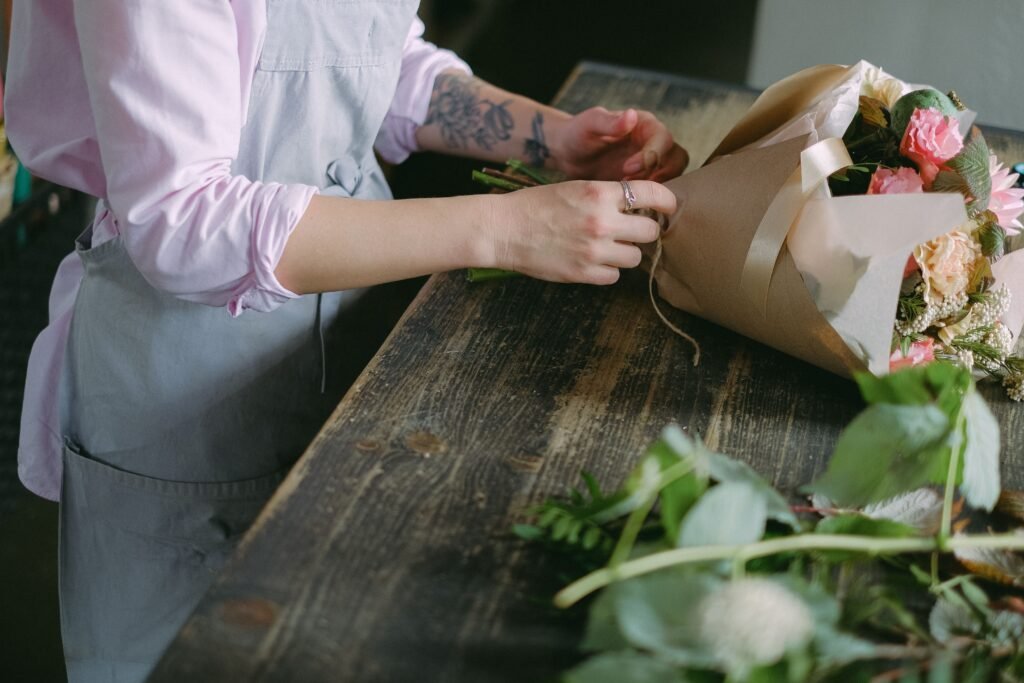
A hand-arranged bouquet is designed by a florist who selects, trims, and places each stem individually, then delivers it already arranged in a vase or wrap, ready to display. The florist controls the final look from start to finish.
A boxed bouquet, by contrast, is prepared for shipping. Stems are typically bundled, secured with rubber bands or ties, wrapped for protection, and packed flat or upright inside a box designed to survive transit — often through a shipping carrier rather than a local delivery driver. The recipient then has to unpack the flowers, trim the stems, and arrange them at home.
Boxed bouquets aren’t automatically inferior. Some are carefully packed and arrive in excellent condition, and they can be a practical option for long-distance gifting. But the recipient experience is different: instead of opening the door to a finished arrangement, they’re doing some assembly themselves. If presentation on arrival matters — for an anniversary, a hospital visit, or a first-impression gift — a hand-arranged bouquet from a local shop generally delivers a stronger moment.
When Local Wins
A local florist tends to make the most sense when the recipient is nearby and the occasion is time-sensitive or personal. If you live in or near Toluca Lake, working with a Toluca Lake florist instead of a national site means someone local hand-arranges the stems and can deliver same-day across the neighborhood, including nearby areas like Burbank, Studio City, and Universal City. That local proximity is especially useful when freshness, presentation, and timing all matter at once. Before ordering, it’s worth checking the shop’s same-day cutoff and substitution policy so you know exactly what to expect if a specific flower isn’t in stock that day.
Local florists also tend to be the better choice when you want a specific style — say, a garden-style arrangement with particular colors, or something that matches a venue’s decor. Because you can call or message the shop directly, adjustments are usually easier to communicate than through a national site’s customer service queue.
When a National Flower Site Makes More Sense
National online flower delivery makes the most sense when distance is the deciding factor. If you’re sending flowers to a relative in another state, or you need coverage across multiple cities for a business account, a national platform’s broad delivery network is genuinely useful in a way a single local shop can’t match.
These services also make sense if convenience is your top priority — a standardized checkout, saved payment details, and predictable pricing tiers can be worth the trade-off in customization, especially for lower-stakes occasions like a casual “thinking of you” gesture rather than a major event.
Customization and Substitution Considerations
Customization is usually stronger with local florists, since you can ask for specific flowers, colors, container styles, or size adjustments directly. National sites tend to offer a fixed menu of pre-designed arrangements with limited ability to modify beyond swapping the size tier.
Substitutions are common in both models, and that’s not necessarily a problem. Flower availability shifts by season, by supplier, and even by day, so almost every florist reserves the right to substitute similar stems when something specific runs out. What matters is the substitution policy itself. Look for language indicating that any substitution will preserve the arrangement’s overall appearance, color balance, style, and approximate value — rather than a vague policy that allows for a completely different bouquet at the same price.
Price Expectations: What $70–$200 Actually Buys
Realistic flower arrangements — from either a local shop or a national site — generally range from about $70 to $200, depending on size, flower type, seasonal availability, container choice, and delivery or service fees. Premium flowers like peonies or garden roses, larger arrangements, and same-day service typically push costs toward the higher end of that range.
The advertised “starting price” on a national site’s homepage is often the smallest, most basic option, before delivery fees, service charges, and taxes are added. By the time those are included, the final total can be noticeably higher than the number that first caught your eye. It’s worth comparing the full checkout price — not just the headline figure — across a couple of options before deciding. A cheaper starting price sometimes reflects a smaller arrangement or a boxed bouquet rather than the same product at a discount, so it pays to look closely at what’s actually included.
Customer Support and Accountability
If something goes wrong — a late delivery, a wilted arrangement, or a design that doesn’t match what you ordered — local florists are usually easier to resolve issues with directly. You’re speaking with the person or team who actually made the arrangement, which tends to make problem-solving faster.
National sites route support through call centers or chat systems, and because they may not have made the arrangement themselves, resolving an issue can take longer or involve more back-and-forth. That’s not true of every national service, but it’s a common enough pattern that it’s worth factoring into your decision, especially for time-sensitive occasions.
How to Vet a Local Florist
Not every local shop delivers a great experience, so it helps to do a little checking before you commit, especially if you haven’t ordered from them before.
Look at recent customer reviews. Pay attention to comments specifically about freshness, delivery timing, communication, and whether the finished arrangement matched what was ordered — not just star ratings.
Confirm a real physical address. A legitimate local florist should have an actual storefront or verifiable location, not just a website and a phone number. This matters for accountability and for confirming they genuinely serve your delivery area.
Check the same-day cutoff time clearly. A trustworthy shop will state exactly how late you can order for same-day delivery, rather than leaving it vague. If that information is hard to find, it’s worth calling to ask directly.
Look for photos of actual completed work. Genuine arrangement photos, ideally showing a range of past orders, tell you more about real quality than generic stock imagery on a template website.
Read the substitution policy before you order. A clear, specific policy shows the florist has thought through how they’ll handle changes, rather than leaving buyers to find out the hard way.
Making the Practical Decision
Start with two questions: how far away is the recipient, and how much does presentation matter for this occasion? Nearby recipients and detail-sensitive moments tend to favor a local florist; long-distance recipients and lower-stakes gestures tend to favor a national service’s reach and convenience.
From there, compare total price rather than the advertised starting price, check delivery windows against your actual deadline, and if you’re going local, spend a few minutes checking reviews and the substitution policy. That small amount of research prevents most of the common disappointments on either side.
Frequently Asked Questions
Is a local florist more expensive than a national flower website? Not necessarily. Prices from both tend to fall in a similar range once delivery and service fees are factored into the national site’s total. Local florists sometimes come out even, or cheaper, once you account for the fact that you’re paying for hand-arranged flowers rather than packaging and shipping costs.
Do national flower websites just use local florists anyway? Often, yes — many national platforms operate as a network that forwards your order to a local florist in the recipient’s area, who then arranges and delivers it. Others fulfill orders through centralized facilities and ship a boxed bouquet directly. It’s worth checking a specific service’s fulfillment model if that distinction matters to you.
How late can you typically order same-day flower delivery? This varies by florist, but many local shops set a cutoff somewhere in the early-to-mid afternoon, often between noon and 2 p.m. local time. Always confirm the exact cutoff with the specific florist or site you’re using, since it can shift based on season, staffing, and delivery zone.
What does a flower substitution policy actually mean? It’s the florist’s stated approach to replacing flowers that aren’t available when your order is prepared. A well-written policy explains that any substitutes will match the original arrangement’s color scheme, style, size, and overall value, rather than allowing an unrelated swap.
How do you check whether a local florist is legitimate before ordering? Look for recent, specific customer reviews, a verifiable physical address, clearly stated same-day cutoff times, real photos of completed arrangements, and a transparent substitution policy. If a shop is vague or missing several of these, it’s worth a quick phone call before you place an order.
Final Thoughts
There’s no single right answer between a local florist and a national flower delivery site — the right choice depends on where the recipient lives, how much the presentation matters, and how quickly the flowers need to arrive. Once you know what you’re actually optimizing for, the decision usually becomes straightforward, and you can order with confidence instead of guessing.